As medical equipment becomes increasingly intelligent and integrated, stool analyzers, which integrate high-sensitivity optical detection modules, precision motor drive systems, and high-speed data communication interfaces, face increasingly stringent requirements for electromagnetic interference (EMI) and electromagnetic immunity (EMS).
Stool Analyzer Module Diagram
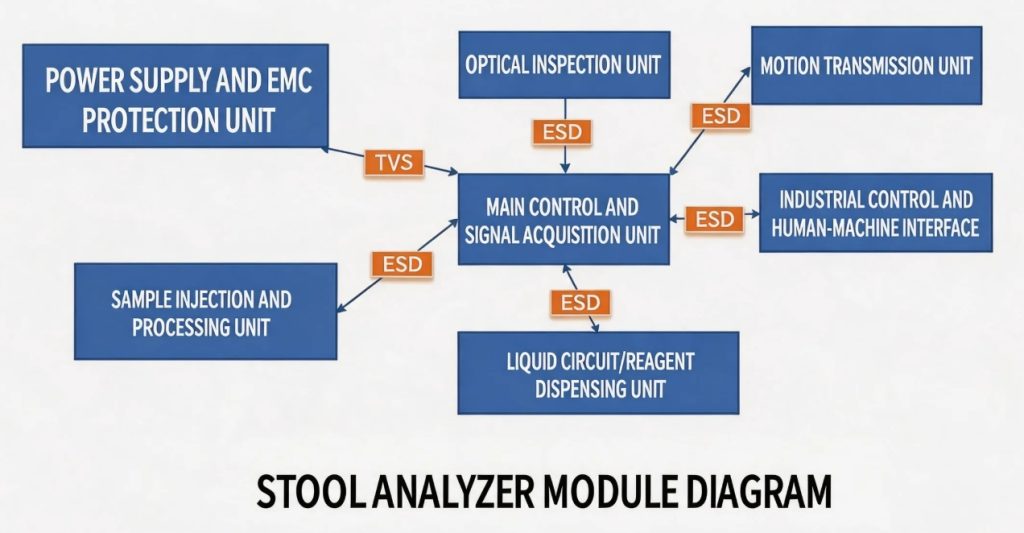
In accordance with international regulations such as IEC 60601-1-2 General Standard for Electromagnetic Compatibility of Medical Electrical Equipment, stool analyzers must pass multiple EMC tests, including electrostatic discharge (ESD), electrical fast transient/burst (EFT), surge, and power frequency magnetic field tests, to ensure stable operation in the complex electromagnetic environment of hospitals.
I. Functions and EMC Protection Architecture of the Fecal Analyzer
1️⃣ Core Functional Modules
The fully automated fecal analyzer mainly consists of the following five core modules:
- Sample Processing Module: Automatic sample introduction, sample mixing, smear preparation
- Optical Detection Module: Microscopic imaging, photoelectric signal acquisition and conversion (core sensitive unit)
- Main Control Processing Module: Data processing, algorithm analysis, result determination
- Human-Machine Interaction Module: Touch screen, button operation, print output
- Communication Interface Module: USB, RS-232/485, Ethernet, enabling data upload and remote control
2️⃣ EMC Protection Architecture
The EMC protection of the fecal analyzer follows the design principle of "layered protection and step-by-step discharge," constructing a three-level protection system of "external interface protection - internal circuit protection - sensitive module isolation":
- External Interface Layer: Independent surge, electrostatic discharge, and EFT protection are implemented for all external interfaces to block interference from entering the equipment;
- Internal circuit layer: Key power supplies and signal links are enhanced with filtering, clamping, and isolation measures to suppress conducted interference;
- Sensitive module layer: Optical detection and weak signal acquisition units employ opto-isolation, differential wiring, and shielded grounding to prevent radiated interference from affecting imaging accuracy.
Semiware Semiconductor has been deeply involved in EMC protection for 15 years. Addressing the typical EMC pain points of fecal analyzers, it has launched a comprehensive, one-stop protection solution for all interfaces, helping to improve product reliability and market competitiveness.
II. EMC Protection Schemes for Various Interfaces and Semiware Component Selection
1. AC 220V Power Interface Protection
The AC power interface serves as the entry point through which the stool analyzer connects to an external 220V AC power supply; it also acts as the primary conduit for the ingress of surges and conducted interference into the device. In accordance with the IEC 60601-1-2 standard, the power ports of medical equipment are required to withstand differential-mode surge tests of ±2kV and common-mode surge tests of ±4kV.
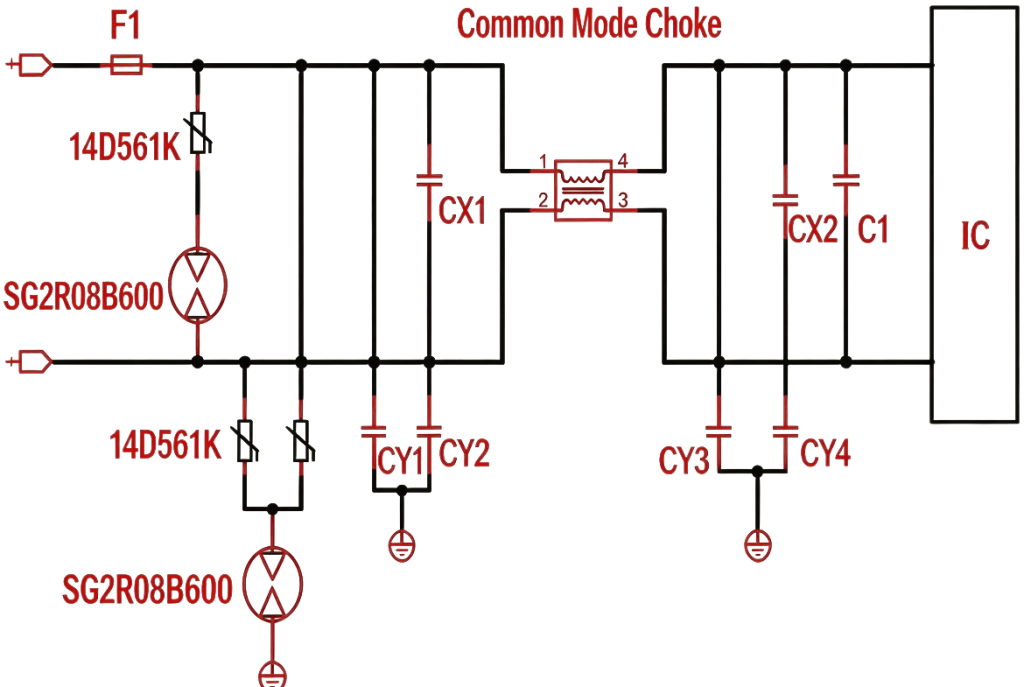
Semiware employs a combination of Gas Discharge Tubes (GDTs) and Metal Oxide Varistors (MOVs) to effectively divert these surges.
2. 12V/24V DC Power Interface Protection
The DC power interface is used to connect to an external 12V/24V DC power supply or battery, facilitating mobile operation. This interface is similarly susceptible to threats from surges and Electrostatic Discharge (ESD); consequently, it must comply with the requirements of the IEC 61000-4-2 standard, specifically withstanding contact discharges of ±8kV and air discharges of ±15kV.
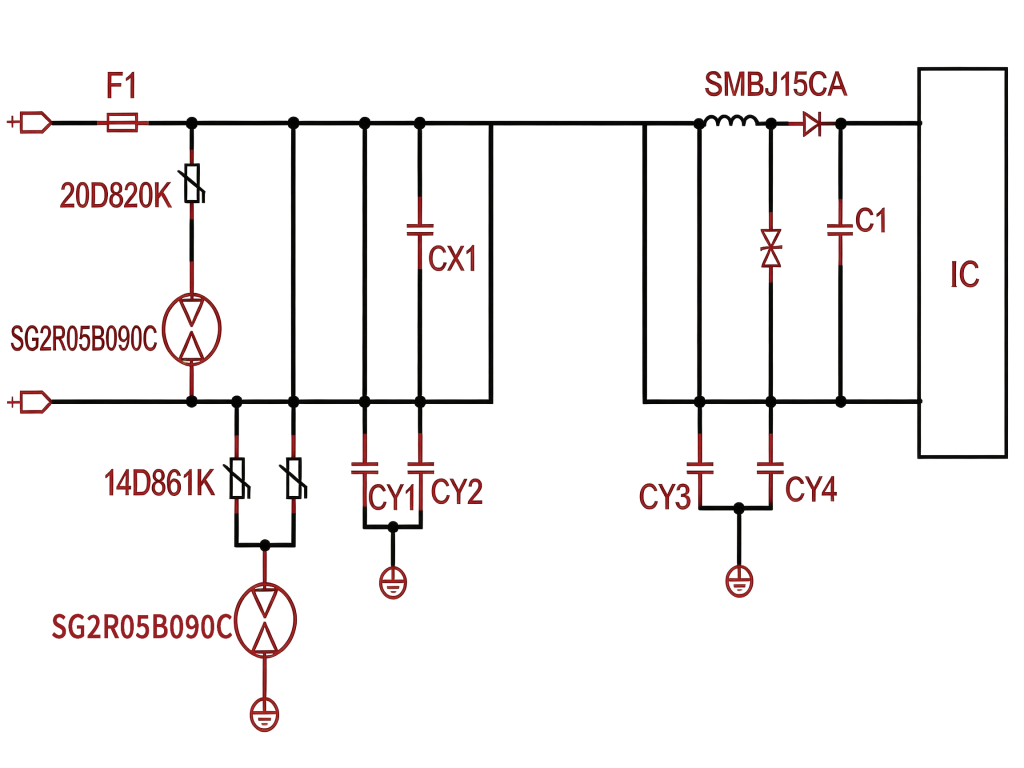
Semiware recommends utilizing a combination of GDTs and MOVs to provide primary-stage surge protection, effectively discharging high-energy surges;
Additionally, a Transient Voltage Suppressor (TVS) is recommended for secondary-stage fine protection, serving to clamp the voltage within a range that the downstream circuitry can safely tolerate.
3. USB 2.0/3.0 Interface Protection
The USB 3.0 interface features high-speed data transmission capabilities (reaching up to 5Gbps) and is widely used to connect the device to external storage media, sensors, and other peripherals. The high-speed differential signals involved place extremely stringent demands on the junction capacitance and differential impedance matching characteristics of the protection components used.
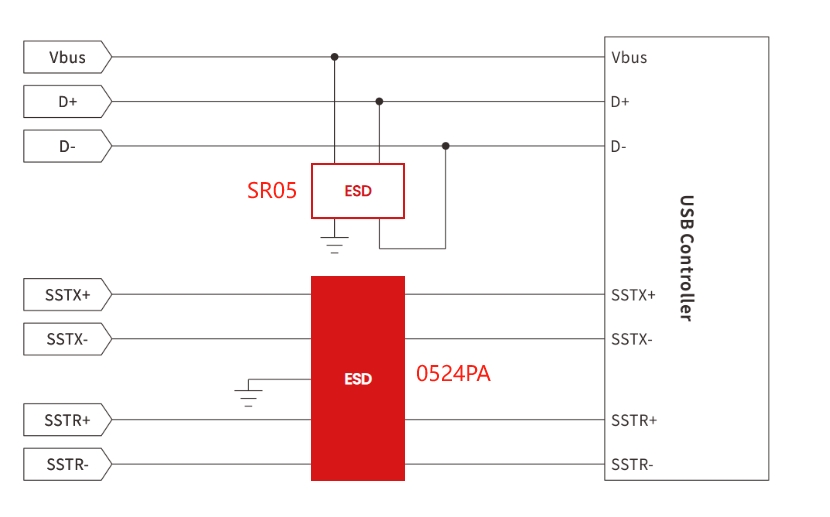
Semiware employs a discrete component protection scheme to ensure signal integrity and effectively filter out common mode interference. This solution fully complies with the IEC 61000-4-2 standard (Level 4), meeting the requirements for 8kV contact discharge and 15kV air discharge.
4. RS-232/RS-485 Interface Protection
RS-232 and RS-485 serial ports are used to connect external peripherals—such as printers and barcode scanners—and therefore require protection against both ESD and surge interference.
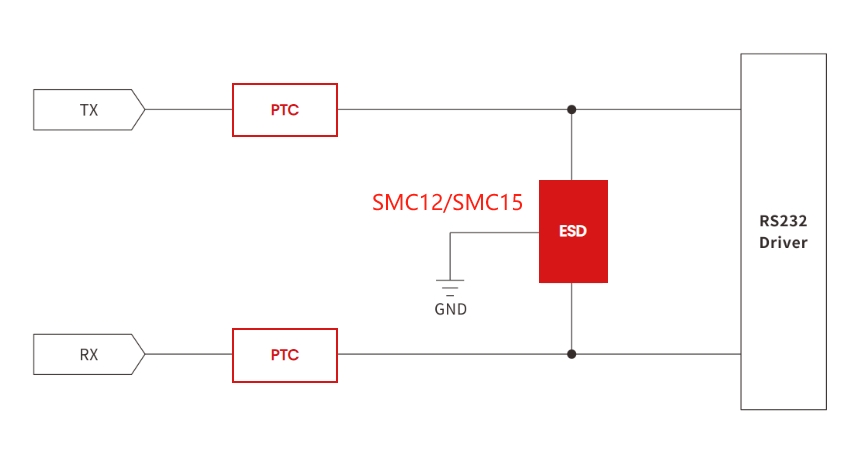
For RS-232 applications, Semiware recommends the use of the integrated devices SMC12/SMC15:
- They ensure signal integrity while successfully passing ESD testing;
- They meet the requirements of IEC 61000-4-2 and ISO 10605-2 (Level 4), withstanding contact discharge of 8 kV and air discharge of 15 kV.
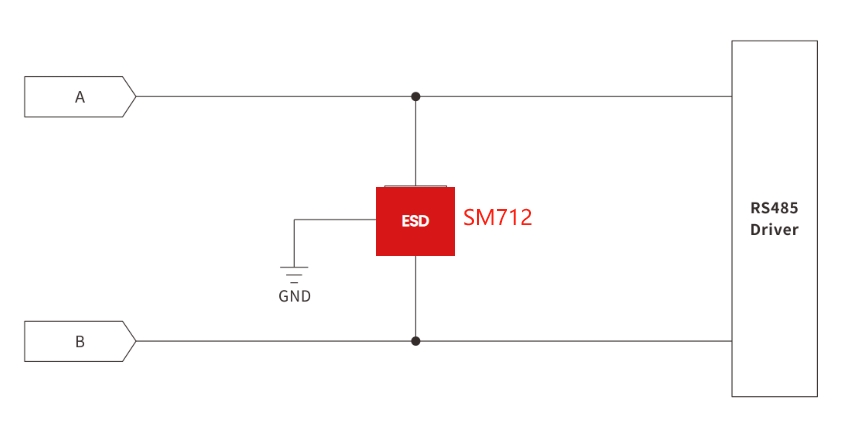
For RS-485 applications, Semiware recommends the multi-channel integrated device SM712:
- This device ensures signal integrity and filters out noise while successfully passing ESD compliance testing;
- It meets the requirements of IEC 61000-4-2 and ISO 10605-2 (Level 4), withstanding contact discharge of 25 kV and air discharge of 25 kV.
5. Ethernet Interface Protection
For semi-automated stool analyzers equipped with network connectivity, the Ethernet interface requires simultaneous protection against ESD, EFT, and surge interference.
Semiware’s solution for 1000 Mbps Ethernet port surge protection employs a two-stage protection design:
- It complies with the IEC 61000-4-2 standard (Level 4), supporting both contact discharge and air discharge levels of ±30 kV;
- It also meets the requirements of the IEC 61000-4-5 standard, withstanding a 10/700 µs waveform at a 40 Ω impedance and 6 kV voltage, while maintaining stable signal transmission even in high-temperature environments.
III. Summary of Semiware Component Models for EMC Protection in Fecal Analyzers
| Part Number | Device Type | Specifications | Application |
| SG2R08B600 | GDT (Gas Discharge Tube) | 600V ±20%, 10kA (8/20μs) | AC power line surge protection |
| SMBJ15CA | TVS Diode | 15V, 600W, bidirectional, 24.6A | DC power interface protection |
| SMBJ28CA | TVS Diode | 28V, 600W, bidirectional | 24V DC power protection |
| SR05 | ESD Protection Device | 5V, 2pF, 3-channel | USB 2.0 / USB 3.0 interfaces |
| SM712 | TVS / ESD Protection | 7V/12V, bidirectional, 17A | RS485 communication protection |
| SG3D05B090 | Three-electrode GDT | 90V, 5kA | Ethernet surge protection |
| GBLC03CI | ESD Protection Device | 3.3V, bidirectional, 20A | Ethernet interface protection |
| SE10F10U5.0MA | ESD Protection Array | 5V, unidirectional, 0.7pF, 2-channel | USB 2.0 D+/D− ESD protection |
Conclusion
EMC protection for stool analyzers is a comprehensive systems engineering undertaking; it involves not only the selection of protective components but also requires end-to-end optimization—ranging from schematic design and PCB layout/routing to the structural design of the complete device.
Leveraging 15 years of expertise in EMC protection, Semiware has established a robust system for product and technical support. This system encompasses a full spectrum of protective devices—including Gas Discharge Tubes (GDTs), Metal Oxide Varistors (MOVs), TVS diodes, ESD arrays, and semiconductor discharge tubes—and is backed by a professional team of Field Application Engineers (FAEs) ready to provide expert guidance on component selection and application support.
👉 If you are currently engaged in the EMC design of medical diagnostic equipment or stool analyzers, we invite you to contact us. https://en.semiware.com/contact/