Introduction
The fire alarm two-wire bus is a technology that combines communication and power supply over a single pair of wires, simultaneously transmitting 24V/28V DC power and communication signals. It is widely used for networked communication between fire alarm control panels, detectors, and various fire alarm modules.
So, what are the characteristics of the fire alarm two-wire bus, and how can reliable interface protection be achieved?
I. Characteristics of the Fire Alarm Two-Wire Bus
Compared to traditional multi-wire systems, the two-wire bus requires only a single pair of wires for both power supply and data communication, significantly reducing wiring costs and installation complexity. Its main features include:
- Power supply and communication via two wires, reducing wiring costs;
- Long transmission distance, with a theoretical communication range of up to 1,500 meters;
- Flexible networking, supporting topologies such as bus and star configurations;
- Support for protocols like Modbus RTU, facilitating system integration.
II. Electrical Threats Facing the Fire Alarm Two-Wire Bus
Since bus lines typically span an entire building—or even connect multiple floors—they are susceptible to electrical threats such as lightning-induced surges, electrostatic discharge (ESD), and short circuits.
Damage to the bus interface can range from communication anomalies to detectors going offline, false alarms, or even a complete system failure.
Common risks include:
| Threat | Typical Source |
| Surge | Lightning induction, power switching events |
| ESD | Human contact during installation or maintenance |
| Overcurrent | Short circuits, wiring errors, equipment failures |
III. Overall Protection Strategy and Principles
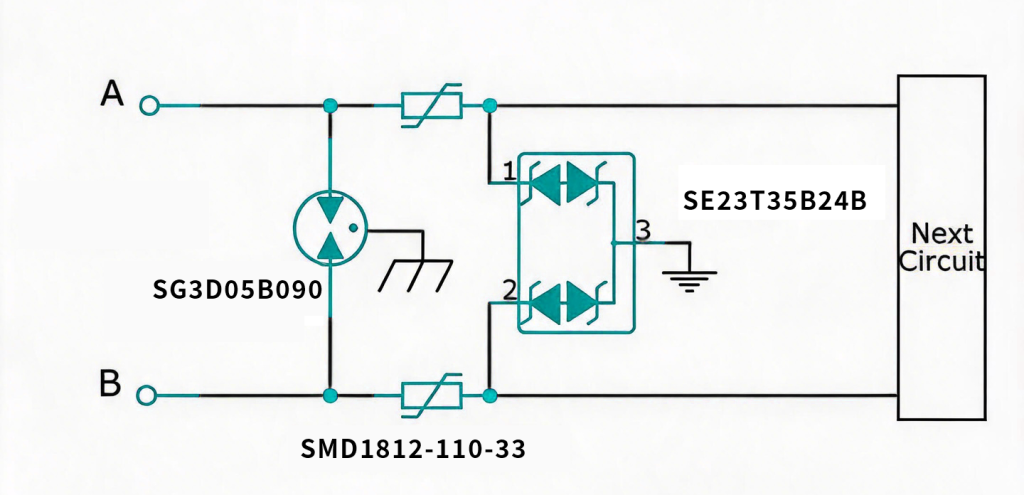
To enhance long-term system stability, a three-stage protection architecture utilizing GDT, PPTC, and TVS components is recommended.
Level 1 Protection: GDT for Surge Energy Dissipation
When the line is subjected to lightning-induced surges: The GDT activates first, shunting the majority of the surge current to the ground and reducing the impact energy experienced by downstream components.
👉 Suitable for protecting long-distance fire alarm bus lines in buildings.
Level 2 Protection: PPTC for Fault Current Limiting
In the event of a bus short circuit, module failure, or wiring error:
The PPTC rapidly increases its resistance to limit current, preventing sustained overcurrent from causing line overheating or component burnout. It automatically resets once the fault is cleared.
Level 3 Protection: TVS Absorption of Residual Surges and ESD
TVS diodes feature nanosecond-level response speeds, enabling precise clamping of residual surges and ESD to protect MCUs, bus transceivers, and communication interface chips.
At the same time, this ensures the signal integrity of PowerBus communications.
III. Semiware Recommended Protection Devices
| Part Number | Device Type | Key Parameters | Channel | Package |
| SE23T35B24B | TVS Diode | 24V, 50pF, IPP=7A, ±30kV Air / Contact Discharge | 2-channel,Bidirectional, | SOT-23 |
| SD24C | TVS Diode | 24V, 24pF, IPP=7A, ±30kV Air / Contact Discharge | 1-channel, Bidirectional | SOD-323 |
| SG3D05B090 | Gas Discharge Tube | 90V ±20%, 1.5pF, 5kA Surge Capability | 2-channel,Bidirectional | Ø 5*7.5mm |
| SMD1812-110-33 | PPTC Resettable Fuse | 33V, Hold Current 1.1A, Initial Resistance 0.25Ω | / | SMD1812 |
IV. Test Levels
- IEC 61000-4-2 ESD: ±30kV Contact, ±30kV Air
- ISO 10605: Level 4
- Surge Protection: Enhances system surge immunity
V. Typical Application Scenarios
This solution is suitable for:
- Fire alarm control panels
- Smoke detectors
- Heat detectors
- Input/output modules
- Manual call points
- Linkage control equipment
- Fire alarm voice evacuation systems
Conclusion
The three-level protection architecture—comprising GDTs, PPTCs, and TVS diodes—simultaneously addresses issues related to lightning surges, electrostatic discharge (ESD), and overcurrent faults. While ensuring communication stability, it significantly improves the long-term reliability and field interference immunity of fire alarm two-wire bus devices.