Overview
As enterprise communication systems evolve towards digitalization and networking, traditional PBXs (Private Branch Exchanges) are gradually being replaced by IP PBX systems based on the IP protocol.
Compared to traditional dedicated switches, IP PBXs enable voice communication, remote management, resource sharing, and integration with other business systems via IP networks, significantly improving the flexibility and scalability of communication systems.
However, networking also means that PBX equipment needs to face more electrical threats from the external environment. Interfaces connecting external devices, such as telephone lines, Ethernet interfaces, and power ports, can all become pathways for electrostatic discharge (ESD) and surges to enter the system.
- Major Transient Threats Faced by IP PBX Systems
1.1 Electrostatic Discharge (ESD)
ESD is one of the most common transient threats to electronic equipment.
In a PBX system, users may generate static electricity (ESD) through:
- plugging or unplugging telephone or network cables
- contacting equipment interfaces by maintenance personnel
- connecting external terminal equipment
Although ESD duration is very short, its instantaneous voltage can reach thousands of volts. If ESD directly enters the internal circuitry, it can cause:
- damage to communication chips
- abnormal system restarts
- data transmission errors
- interface malfunction
Therefore, adding ESD protection devices to RJ45, telephone interfaces, and other external connection ports is a key measure to improve system reliability.
1.2 Lightning Surges and Line Transients
PBX systems typically connect to numerous external lines, such as:
- telephone lines
- long-distance communication lines
- Ethernet networks
- external expansion terminals
These lines are susceptible to the following:
- lightning induction
- grid fluctuations
- ground potential changes
- transient voltages generated by equipment switching
Especially in outdoor lines or cross-building connections, surges can enter the PBX equipment through communication cables, causing high-energy impacts on the internal circuitry.
- Key Protection Points in IP PBX Systems
Different interfaces face different threats, therefore, targeted protection designs are required.
2.1 Telephone Line Interface Protection
Traditional analog telephone interfaces (FXS/FXO) and SLIC interfaces are typically directly connected to external lines, making them critical locations for surge protection.
Recommended Protection Scheme:
- GDT (Gas Discharge Tube): Used to discharge high-energy surge currents, suitable for lightning surge protection.
- TSS (Thyristor Surge Suppressor): Provides fast triggering and low residual voltage protection, improving the safety of back-end ICs.
- TVS Diode: Used to limit residual voltage, protecting sensitive semiconductors.
A multi-level protection structure can balance high current discharge capability and low clamping voltage requirements.
2.2 Ethernet/IP Network Interface Protection
IP PBXs rely on Ethernet for data and voice transmission, therefore RJ45 interface protection is equally important.
Design considerations:
- ESD protection capability
- Low parasitic capacitance
- High-speed signal integrity
- Surge tolerance
For high-speed network interfaces, ESD protection devices need to provide protection while avoiding interference with high-speed signal transmission.
2.3 Power Interface Protection
PBX equipment contains numerous digital ICs, power management chips, and communication modules.
Power ports may be affected by:
- Input voltage surges
- Power switching transients
- Reverse connection
TVS diodes are typically used for power input protection, limiting overvoltage through fast response and protecting downstream circuitry.
- Semiware IP PBX Protection Solutions
Semiware offers complete ESD and surge protection solutions for communication equipment applications, including:
- TVS diodes
- ESD protection diodes
- GDT gas discharge tubes
- TSS thyristor surge protectors
These protection devices can be applied to:
- IP PBX systems;
- VoIP Gateways;
- SLIC interfaces;
- Ethernet communication equipment;
- Industrial communication terminals.
By appropriately selecting protection devices and combining them with system design requirements, engineers can improve equipment reliability and reduce maintenance costs caused by transient events.
Reference design block diagram
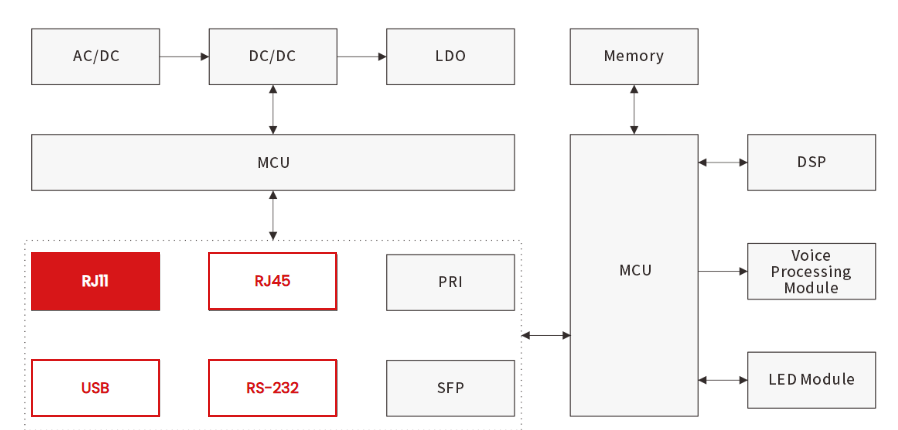 ESD) and Surge Protection in IP PBX Systems" class="wp-image-18303"/>
Learn more about Semiware PBX protection solutions: