I. What is a Gas Leak Detector?
In fields such as industrial safety and home security, gas leak detectors are primarily used to monitor the concentrations of combustible gases and hazardous gases (like carbon monoxide/CO) in real-time, triggering an alarm promptly when abnormalities are detected.
As gas detection equipment evolves toward greater intelligence—integrating features such as voice alerts, data logging, and wired or wireless communication—new challenges arise for hardware design.
This article examines the hardware architecture of gas leak detectors, analyzes common circuit design challenges, and introduces the application and selection criteria for discrete components—such as TVS diodes, ESD suppressors, and Schottky diodes—at various circuit locations.

II. Hardware Design Challenges for Gas Leak Detectors
During actual product development, the hardware design challenges for gas detectors typically center on sensor signals, power supplies, external interfaces, EMC/ESD considerations, and power consumption.
2.1 Sensor signals are susceptible to external interference
Gas sensor output signals generally require processing steps such as amplification, filtering, and ADC sampling. Power supply noise, EMI, or external transient interference can easily couple into the sensor signal path.
For low-level, high-impedance sensor signals, excessive leakage current from protection components can affect signal integrity, while excessive parasitic capacitance may alter signal response characteristics.
2.2 External interfaces face ESD and transient voltage risks
External interfaces on gas detectors (such as buttons, USB ports, and communication ports) can serve as entry points for electrostatic discharge (ESD) or transient interference to reach the device's internal circuitry.
Without proper protection measures, transient energy can couple into the MCU, communication ICs, or sensor interfaces, causing device resets, communication errors, or even component damage.
2.3 Power inputs are susceptible to surges and reverse polarity
Gas detectors utilize various power sources, including:
- AC/DC adapters
- Industrial DC power supplies
- Batteries
- External control cabinet power supplies
Power input terminals may be affected by anomalies such as switching transients, voltage fluctuations, and reverse polarity connections.
2.4 Communication interfaces require a balance between protection and signal integrity
When gas detectors incorporate interfaces like RS-485, USB, or other data ports, the protection design must ensure adequate protection capabilities without compromising signal integrity.
2.5 The BOM must balance performance, size, and cost.
Gas detection equipment typically requires the integration of multiple modules (sensors, MCUs, power management, displays, etc.) within limited PCB space. Therefore, in addition to meeting electrical performance requirements, the selection of protection components must also take into account package size, supply stability, cost, and consistency in mass production.
III. Circuit Protection Essentials for Gas Leak Detectors
Targeted protection for power supplies, sensors, MCUs, and communication interfaces can be implemented using discrete components—such as TVS diodes, ESD suppressors, Schottky diodes, and Zener diodes—tailored to the operating characteristics of each circuit module.
3.1 Power Input Protection
TVS diodes can be used at the power input to suppress external surges and transient voltages. For battery or DC inputs, Schottky diodes may be employed to provide reverse-polarity protection or to design low-loss power paths, depending on the circuit topology.
3.2 Sensor and Signal Interface Protection
Sensor interfaces are sensitive to leakage current and parasitic capacitance. It is recommended to prioritize ESD protection devices with low leakage current and low capacitance; this ensures transient protection while minimizing interference with sensor sampling signals.
3.3 MCU and Communication Interface Protection
For external interfaces such as MCU GPIOs, RS-485, UART, and USB, ESD diodes should be selected based on operating voltage and signal data rates. For high-speed communication interfaces, particular attention must be paid to the parasitic capacitance of protection components to avoid compromising signal integrity.
3.4 Alarm Driver Protection
Switching operations for loads such as buzzers and voice modules can generate transient voltages. Depending on the specific load and driver topology, components such as Zener diodes, TVS diodes, Schottky diodes, MOSFETs, or BJTs can be used to implement the driving and protection circuitry.
IV. Semiware Circuit Protection Solutions for Gas Leak Detectors
Semiware offers a range of discrete components—including TVS diodes, ESD suppressors, Schottky diodes, and Zener diodes—to provide circuit protection for critical areas of gas detection equipment, such as power supplies, sensors, MCUs, and communication interfaces.
Reference Design Block Diagram
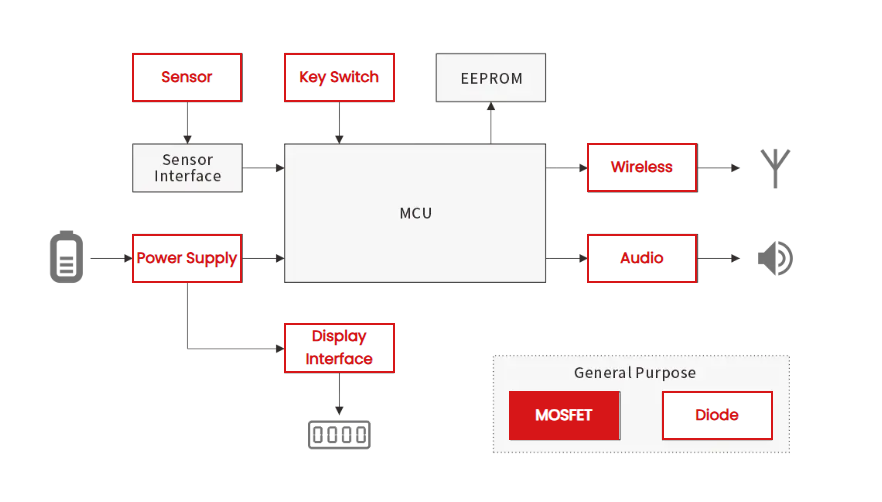
For specific component selection and application details, please visit:
https://en.semiware.com/applications/industrial-gas-alarm
V. Typical Applications of Industrial Gas Leak Detectors
Industrial gas leak detectors are primarily used in industrial environments where combustible, toxic, or hazardous gases may be present, such as:
Chemical and Petrochemical Industries: Used for gas concentration monitoring and anomaly alerts in production workshops, tank farms, and pipeline areas.
Oil, Gas, and Energy Facilities: Used for continuous gas monitoring and remote data transmission at gas stations, energy equipment sites, and related facilities.
Industrial Plants and Equipment Areas: Used for real-time detection in production workshops and equipment rooms, providing alarm outputs via audible and visual signals, voice alerts, or communication interfaces.
Conclusion
When designing the hardware for gas leak detectors, engineers must focus not only on the sensor and MCU but also on the following key considerations:
- Surge and transient protection for power inputs;
- Low-leakage protection for sensor interfaces;
- ESD protection for the MCU and external interfaces;
- Protection and signal integrity for communication interfaces;
- Low-power design for battery-operated devices;
- Component parameter matching across different circuit sections.
Proper selection of discrete components helps mitigate the impact of ESD, transient voltages, and power anomalies on the system, while balancing requirements for signal integrity, power consumption, and PCB space.
Semiware offers a comprehensive portfolio of discrete semiconductor devices—including TVS, ESD, Schottky, and Zener diodes—providing hardware engineers with circuit protection solutions and component selection support tailored to the specific circuit modules of gas detection equipment.