Introduction
In projects involving smart cities, campus security, and roadside surveillance, IP network cameras constitute the most numerous devices at the very edge of the security system.
Large numbers of cameras are installed directly on outdoor poles or walls; their cabling often spans long distances, exposing them to complex electromagnetic environments. Many projects face a common, practical issue: during thunderstorms or dry seasonal transitions, devices may experience unexplained system freezes, network port failures, or video stuttering. Often, the cause is not a chip defect or firmware bug, but rather latent or direct damage resulting from transient electrical shocks such as surges or electrostatic discharge (ESD).

I. Key Electrical Risks Facing IP Cameras
Outdoor IP cameras face transient overvoltage threats primarily from lightning-induced surges, power grid disturbances, and electrostatic discharge (ESD). These threats typically enter the device through two external interfaces: the power input and the RJ45 network port (including PoE connections).
1.1 Surges
- Sources: Long-distance power and network cables are susceptible to induction from lightning electromagnetic fields or transient interference from other lines. This generates high instantaneous voltages and currents with significant energy, typically lasting on the order of microseconds.
- Impact: Once these surges penetrate the device, they can cause dielectric breakdown in power management ICs and network PHY chips, leading to power supply short circuits or network port failure.
1.2 Electrostatic Discharge (ESD)
- Sources: ESD often arises from human contact with interfaces or friction against the device casing in dry environments. ESD events are characterized by high voltage, extremely fast rise times, and very short durations, allowing them to easily couple into internal circuitry via external interfaces.
- Impact: ESD strikes can easily damage the main controller and the peripheral circuitry of the image sensor.
As PoE cameras become increasingly widespread—transmitting both power and high-speed data over a single network cable—protection design becomes more challenging; the network port must withstand transient shocks on the power line while simultaneously protecting high-speed Gigabit data signals.
II. Core Concepts of Protection Design
The overall design logic for outdoor IPCs relies on a staged energy dissipation strategy:
- Front-end components dissipate high-energy surges, while back-end components clamp residual voltage to a safe level that the chips can withstand;
- For high-speed signal ports, the parasitic capacitance of protection components is strictly controlled to avoid interfering with video data transmission.
2.1 Power Interface Protection
Whether using DC power or PoE (Power over Ethernet), protection at the power input is both fundamental and critical.
a. For DC 12V input ports, it is recommended to place a TVS (Transient Voltage Suppressor) diode close to the connector.
When selecting the component, ensure the reverse standoff voltage exceeds the system's normal operating voltage. Allow for a reasonable margin based on the actual operating voltage range, power supply tolerance, and the voltage tolerance of downstream components. This setup absorbs surge pulses from external lines and rapidly clamps overvoltage to protect downstream power management chips.
b. PoE 48V power supply scenarios require addressing both surges on the power lines and signal integrity for high-speed Ethernet data.
For applications requiring higher surge immunity levels, a two-stage or multi-stage protection scheme may be adopted depending on the circuit architecture: high-current components dissipate the bulk of the surge energy, while TVS diodes clamp residual overvoltage—balancing power handling and response speed to meet IEC 61000-4-5 surge test requirements.
Design Tip: Place protection components as close to the connector as possible and minimize the length of grounding traces; excessively long ground traces introduce parasitic inductance, which directly diminishes the effectiveness of the protection.
2.2 RJ45 Network Port Protection
RJ45 network ports are exposed to common-mode and differential-mode surge interference, as well as frequent electrostatic discharge (ESD).
First-stage protection: Gas Discharge Tubes (GDTs) are used for the initial stage of surge dissipation from external lines. In an appropriate protection topology, GDTs can handle significant surge energy; however, due to their relatively slow response speed, they are typically paired with downstream clamping components.
Second-stage surge clamping: Bidirectional TVS devices handle the residual overvoltage remaining after the GDT has operated.
Third-stage ESD protection">ESD protection: Low-capacitance ESD arrays handle electrostatic discharge and high-frequency residual pulses—protecting PHY chip pins without significantly affecting high-speed Gigabit signals.
2.3 Other Auxiliary Interfaces
Some IP cameras (IPCs) also feature peripheral interfaces such as audio output, alarm I/O, and RS485; these exposed pins are also susceptible to electrostatic discharge. Use standard ESD protection">ESD protection devices connected in parallel between the signal line and ground to achieve basic electrostatic suppression.
III. Semiware Protection Design Block Diagram
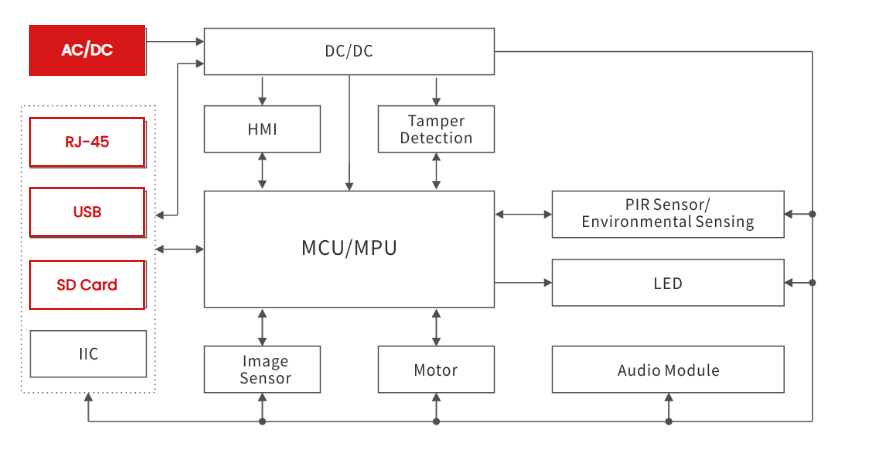
For specific protection schemes, please visit: https://en.semiware.com/applications/ip-camera/
IV. Beyond Hardware: PCB Layout Matters
Even the best circuit board protection requires proper installation; many field failures stem not from board design flaws, but from inadequate grounding.
- Ensure reliable grounding for the camera housing, keeping grounding leads as short and thick as possible;
- Properly shield long-distance Ethernet and power cables, connecting the shielding layers according to the system's grounding and EMC architecture;
- In areas prone to lightning strikes, supplement on-board protection with external PoE surge protectors installed at the mounting pole;
- Conduct comprehensive EMC verification for the entire unit, ensuring it passes relevant tests—such as IEC 61000-4-2 (Electrostatic Discharge) and IEC 61000-4-5 (Surge)—to simulate real-world outdoor operating conditions.
Conclusion
ESD and surge protection for IP cameras are critical factors influencing device reliability and operational stability in the field.
Implementing robust ESD and surge protection during the product development phase not only helps the IPC pass relevant EMC tests but also mitigates risk and enhances the device's long-term reliability.
If you are developing an IP camera, PoE camera, or other outdoor security equipment, contact Semiware to discuss your circuit protection requirements and find a suitable protection solution for your application.