Smart speakers primarily face two types of electrical transient risks: Electrostatic Discharge (ESD) and Surge/Lightning-induced transients. As smart speakers typically incorporate Wi-Fi/Bluetooth, USB, Type-C, audio ports, touch controls, and AC/DC power modules, they feature numerous external interfaces, resulting in widely distributed protection points.
I. Electrostatic Discharge (ESD) Risks
- Sources of Static Electricity
Human contact: Touching the casing, buttons, metal trim, or USB/AUX ports with a hand in a dry environment; the human body can accumulate thousands to tens of thousands of volts of static electricity, discharging via air gaps or direct contact.
Aperture coupling: Static arcs or electrostatic fields penetrating internal PCB components through openings such as microphone pickup holes or speaker grilles, potentially damaging microphone analog circuits or power amplifier pins.
External accessories: Plugging/unplugging USB data cables, audio cables, or chargers, allowing static electricity to enter ports via the cables.
Environment: Carpets, synthetic fiber furniture, and dry winter conditions significantly increase the incidence of static electricity.
- Protection Essentials
Signal lines: Use low-capacitance ESD-TVS diodes; for high-speed USB, prioritize devices with junction capacitance (Cj) < 1pF to avoid signal attenuation or audio quality degradation.
MIC/Audio analog lines: Select ESD diodes with extremely low junction capacitance to prevent distortion of high-frequency audio signals.
PCB layout: Place ESD components close to interface connectors; ensure discharge ground paths are short and wide, and connect to ground via nearby vias to minimize loop inductance.
Structural design: Incorporate insulating barriers at plastic casing openings and isolate metal parts to interrupt static coupling paths.
- Testing Standards
Standard basis: IEC-61000-4-2;
standard consumer-grade benchmarks: ±6kV contact / ±8kV air;
stringent levels for export products: ±8kV contact / ±15kV air.
II. Surge Risks
Although smart speakers typically operate at low power, their power input stages remain susceptible to transient overvoltage. Surges are high-energy overvoltage shocks occurring on a microsecond timescale—far exceeding electrostatic energy levels—and primarily propagate through power supply pathways.
- Surge Sources
Grid side: Lightning-induced surges; voltage spikes on the mains caused by the startup/shutdown of high-power appliances (e.g., air conditioners, induction cooktops) conducted into the speaker's DC input via the power adapter.
Inrush current upon plugging/unplugging the adapter.
Induced surges on long USB power cables.
- Surge Attack Paths
DC power input port (highest risk): 12V/5V power rails from the adapter; power pins of PMICs, LDOs, and Class-D amplifiers.
USB VBUS power pin (for external power supply scenarios).
AUX port connected to long external audio cables.
- Testing Standards
IEC 61000-4-5, 8/20μs current waveform; desktop smart speakers typically require ±1kV to ±2kV protection for power ports.
III. ESD and Surge Protection Design
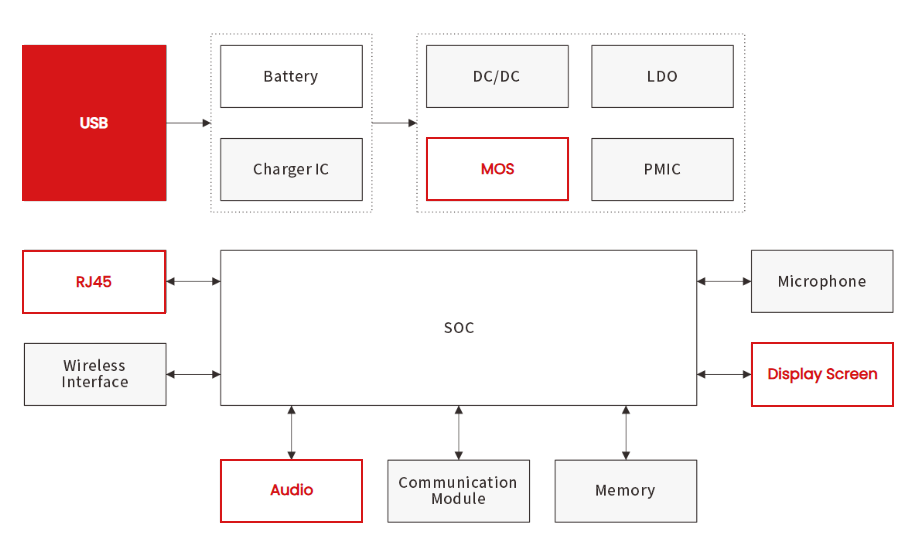
DC power port: Surge TVS + ferrite bead + PMIC-integrated OVP; addresses surges, EFT (Electrical Fast Transients), and ESD.
USB port: Surge + ESD protection on VBUS; ultra-low capacitance ESD arrays for D+/D- lines.
AUX audio port: Bidirectional low-capacitance ESD protection for left/right channels and ground pins.
Microphone array and speaker outputs: Low-power bidirectional ESD protection to prevent ESD ingress through housing openings.
Buttons/touch pins: Single-channel ESD devices placed in close proximity.
PCB: Minimize ground trace length for protection devices; implement partitioned grounding; properly manage analog audio ground vs. protection discharge ground to prevent ground bounce noise from causing audible artifacts in the speaker.
Mechanical design: Insulate metal parts; use labyrinth-style barriers at openings to block radiated ESD coupling.
IV. Circuit Protection Solutions from Semiware
For more details on specific application solutions, please visit: https://en.semiware.com/applications/smart-speaker/
About Semiware
Semiware is a comprehensive provider of circuit protection solutions. Leveraging its semiconductor technology expertise and experience with end-product applications, the company serves customers across the electronics, automotive, and industrial markets.
We offer a comprehensive portfolio of circuit protection devices to meet customer needs, including overvoltage protection, overcurrent protection, composite protection, discrete components, and advanced packaging technologies.
For the latest information on Semiware's products and technologies, please visit our official website: