📌 Introduction
An automotive Head-Up Display (HUD) system typically comprises a Picture Generation Unit (PGU), display or light source drivers, high-speed image transmission links, vehicle communication interfaces, and multi-rail power conversion circuits.
These circuits operate continuously in environments characterized by fluctuations in the vehicle's power supply, electrostatic discharge (ESD), and transient interference. Without targeted protection at critical nodes, external electrical stress can propagate to sensitive downstream components, increasing the risk of issues such as screen blackouts, system reboots, and communication failures.
Therefore, the appropriate use of protection components—such as TVS diodes, ESD diodes, MOSFETs, and Schottky diodes—is an essential aspect of HUD hardware design.
📌 Key Electrical Risks in HUDs and Semiware’s Discrete Component Protection Solutions
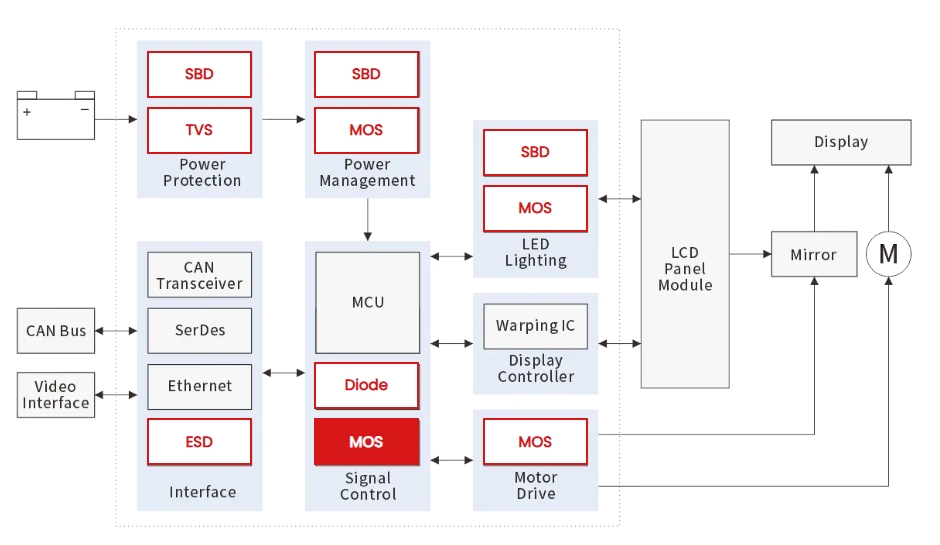
Protection designs must select suitable discrete components based on the specific location of each circuit module within the HUD.
- Power Input: Addressing Surges, Load Dump, and Reverse Polarity
Risk Sources:
HUDs are typically powered by the vehicle's 12V supply. Events such as vehicle load switching or changes in alternator operating states can generate transient voltages on the power line; notably, "load dump" represents a power transient characterized by high energy and relatively long duration.
Impact:
Inadequate protection can lead to overvoltage in DC-DC power components, HUD system reboots, or even damage to downstream circuitry.
Protection Solutions:
Automotive-grade TVS diodes can be employed at the power input to clamp transient overvoltages, limiting abnormal voltage levels to a range that downstream components can withstand.
To guard against reverse polarity—which may occur during vehicle maintenance or wiring harness connection—Schottky diodes or MOSFETs can be used for reverse polarity protection, depending on specific power and efficiency requirements.
- High-Speed Image Interfaces: Balancing ESD Protection and Signal Integrity
Risk Sources:
Internal HUD image transmission often utilizes high-speed differential links such as LVDS or eDP. Electrostatic discharge (ESD) generated during connector mating/unmating, production assembly, or maintenance can enter display drivers or high-speed interface ICs through these interfaces.
Impact:
This can cause visual artifacts (such as screen distortion), flickering, or communication errors; in severe cases, it may even damage interface components. Protection Strategy:
For high-speed links such as LVDS and eDP, the use of low-capacitance, automotive-grade ESD protection devices is recommended to dissipate ESD energy while minimizing impact on high-speed signals.
Protection devices should be placed as close to the interface as possible to shorten the ESD discharge path.
- CAN / LIN Interfaces: Mitigating Risks from ESD and Transient Interference
Sources of Risk:
HUDs rely on automotive communication interfaces—such as CAN, CAN-FD, and LIN—to obtain vehicle status and driving-related information. These interfaces connect to the vehicle's wiring harness and are susceptible to ESD, transient interference, and potential differences between modules.
Protection Strategy:
Automotive-grade ESD/TVS protection devices matched to the bus operating voltage can be employed at communication ports to reduce the risk of overvoltage stress on CAN/LIN transceivers.
For high-speed communication interfaces like CAN-FD, particular attention must be paid to the parasitic capacitance of protection devices to avoid compromising communication signal quality.
- Light Source and Driver Circuit: Focusing on Overcurrent and Short-Circuit Protection
Sources of Risk:
The HUD's backlight or projection light source is powered by a dedicated driver circuit; during operation, it may be subjected to faults such as short circuits or abnormal loads.
Protection Strategy:
The use of PPTC devices and MOSFETs is recommended to limit abnormal currents, thereby reducing the risk of damage to the light source, PCB traces, and driver components caused by overcurrent.
📌 HUD Circuit Design Reference Block Diagram
👉 Learn more: https://en.semiware.com/applications/head-up-display
📌 Summary of Design Key Points
- Prioritize addressing high-energy surges, load dump, and reverse polarity risks at power ports;
- For high-speed image interfaces, prioritize low capacitance; do not focus solely on ESD withstand voltage ratings, as the protection device itself could otherwise degrade the image signal;
- For communication bus ports, select protection devices specifically designed for bus applications to address both ESD and surges;
- Incorporate overcurrent protection into light source driver circuits to handle short-circuit faults;
- Place protection devices as close as possible to the connector entry point to shorten the discharge path and maximize the device's protective effectiveness.
Conclusion
As a key information display module in the smart cockpit, the HUD must withstand various electrical stresses, including automotive power supply transients, ESD, communication interface interference, and load anomalies.
Semiware offers a comprehensive portfolio of automotive-grade circuit protection discrete components covering smart cockpit modules such as HUDs, instrument clusters, T-Boxes, and domain controllers. We provide technical support ranging from component selection to reference designs, enabling cockpit hardware engineers to rapidly implement protection solutions.
Please contact us to learn more about Semiware’s automotive circuit protection solutions and related components.