Overview
Electric bicycles typically use lithium-ion batteries as their power source. Battery safety depends not only on the quality of the battery cells but also on the protection capabilities of the Battery Management System (BMS).
The BMS is responsible for monitoring the battery status and protecting the battery pack by controlling the charging and discharging process. However, in practical applications, the BMS can still be affected by factors such as overcharging, over-discharging, short circuits, abnormal temperatures, and external transient voltages.
Semiware provides solutions for electric bicycle BMS applications, including power supply surge protection, CAN/RS485 communication interface protection, and MOSFET power control protection, helping to improve the safety and stability of lithium battery systems.
I. Major Safety Risks Faced by Electric Bicycle BMS
1.1 Overcharging and Over-discharging Risks
Overcharging lithium batteries can cause cell temperatures to rise, affecting battery life and even posing safety risks.
The BMS needs to accurately detect voltage and control charging to promptly stop abnormal charging.
Simultaneously, over-discharging can also lead to a decrease in battery capacity and may affect battery cycle life.
1.2 Over-temperature Risk
Batteries may experience temperature rise during high-rate charging/discharging, high-load motor operation, or high ambient temperatures.
Therefore, the BMS needs to monitor battery temperature in real time and, when the temperature exceeds the safe range:
- Reduce charging/discharging current
- Shut down the charging/discharging path
- Trigger protection mechanisms
1.3 Short Circuit and Overcurrent Risk
Short circuits at the battery output, power harness, and load terminals can generate significant transient currents.
The BMS typically controls the charging/discharging circuit through MOSFETs and combines this with overcurrent detection for rapid protection.
1.4 External Surge and ESD Risk
In addition to inherent battery risks, the BMS also needs to withstand electrical shocks from the external environment, such as:
- Charging interface surges
- Transient voltages generated during motor startup
- ESD static electricity generated by user operations
- External interference to the communication interface
These transient interferences can damage the BMS main control chip, communication chip, and power MOSFETs.
II. Semiware Electric Bicycle BMS Protection Solution
2.1 48V DC Power Input Surge Protection Solution
Electric bicycles typically use 36V or 48V lithium battery systems. The power input terminal may be affected by transient overvoltages generated by charging equipment, motor operation, and external circuitry.
Adding a TVS diode to the BMS power input terminal can quickly absorb surge energy, reduce residual voltage, and protect the downstream power management IC and control circuitry.
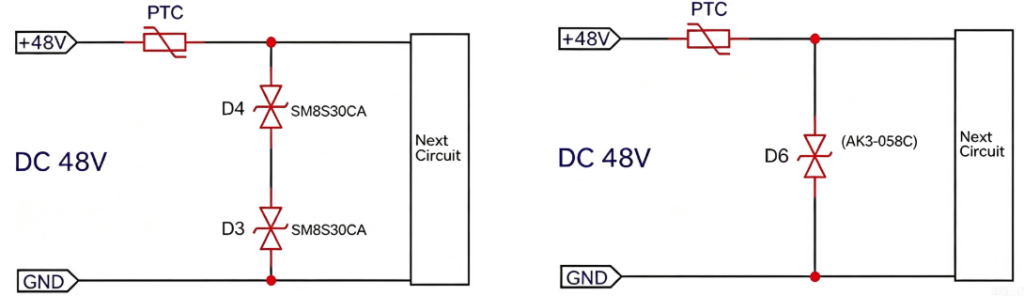
Recommended Components:
| Part Number | Working Voltage | Peak Pulse Power/Current | Package |
| SM8S30CA | 30V | 6600W | DO-218AB |
| SM8S36CA | 36V | 6600W | DO-218AB |
| AK3-058C | 58V | 3kA | AK |
2.2 CAN Interface Lightning Protection Solution
Protection Focus: Surge protection for the CAN interface, using low residual voltage TSS for effective interface protection.
Solution: Using TSS Protection Thyristors
- TSS response time is in the nanosecond range, providing both surge and electrostatic discharge protection while ensuring signal integrity.
- Meets IEC61000-4-2 standards: Electrostatic discharge level 4, contact discharge 15kV, air discharge 8kV;
- IEC61000-4-5 surge 10/700μs, 8KV.
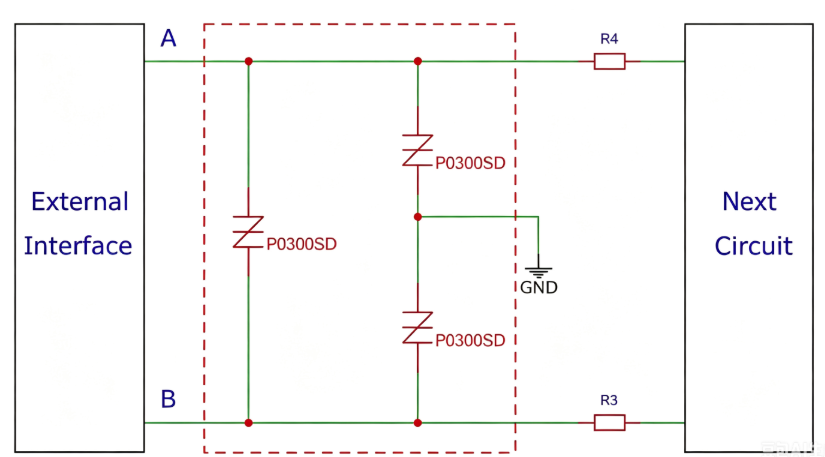
Recommended Components:
| Part Number | Parameter | Package |
| P0300SD | 25V, 50pF, 8KV Surge Protection | SMB (DO-214AA) |
2.3 RS485 Interface Surge Protection Scheme
Key Protection Features: Employs multi-channel integrated device protection to ensure signal integrity while filtering out noise, and passes electrostatic discharge (ESD) testing.
Test Conditions:
- IEC61000-4-2, ISO10605-2 Class 4,
- Contact discharge 25kV, Air discharge 25kV
- IEC61000-4-5 Surge 10/700μs, 8kV
Recommended Components:
| Part Number | Parameter | Function |
| SM712 TVS | 7V/12V, Bidirectional, 55pF | Signal Line Protection |
| SMD1812-050 PTC | 0.5A, 0.15Ω, 15V | Over current Protection |
| SG3D05B090H GDT | 90V, 10KA | High Surge Protection |
III. Advantages of Semiware BMS Protection Scheme
By appropriately combining different protection devices, the BMS system can improve its anti-interference capability, reduce the risk of electronic component damage, and enhance the overall reliability of the electric bicycle.
- TVS Diodes: For power surge and transient overvoltage protection
- TSS/ESD Protection Devices: For CAN, RS485, and other communication interface protection
- GDT: For high-energy surge protection
- PTC Resettable Fuse: For overcurrent protection
Conclusion
From the 48V power input to the CAN/RS485 communication interface and the charge/discharge control circuit, the appropriate selection of protection devices can effectively improve the reliability of lithium battery systems in complex electrical environments.
Semiware can provide protection solutions for new energy sources, battery management systems, and smart devices, helping customers build safer and more stable power systems.
👉 Get in touch with Semiware today for application support and product recommendations.