I. About Residual Current Devices
The primary function of a residual current device (RCD) is to quickly disconnect the power supply when abnormal leakage current is detected, preventing electric shock and equipment damage. It not only needs to detect leakage but also protect its own circuitry.
However, in real-world applications, the RCD itself faces various electrical stresses, such as:
- Power grid surges
- Transient high voltage from lightning strikes
- Peak voltage from power switches
- Electrostatic discharge (ESD)
These transient disturbances can damage the internal electronic control circuitry of the RCD, causing protection failure. Therefore, RCDs also require reliable surge and transient voltage protection solutions.
II. Basic Working Principle of RCDs
RCDs determine the presence of leakage current by detecting residual current in the circuit.
- Under normal circumstances, current inflow and outflow remain balanced;
- When equipment leaks current or a person comes into contact with a live part, some current flows to the ground through an abnormal path, creating a current difference;
- Upon detecting this anomaly, the RCD triggers the tripping mechanism to quickly disconnect the power supply.
III. Key Protection Requirements in RCD Applications
RCDs typically contain detection, power conversion, control, and execution circuits. These electronic components need to withstand different types of electrical risks:
- Input Surge Protection
AC power lines may be affected by lightning strikes or grid fluctuations, generating high-energy surges.
Without effective protection, surges can directly damage:
- Rectifier Circuit
- Control IC
- Trip Drive Section
- Transient Protection of Control Circuits
- The low-voltage control section inside the RCD is more sensitive to overvoltages, requiring TVS diodes to reduce transient voltages.
- Reliable Trigger Protection Action
- The tripping mechanism needs to operate quickly and stably; SCR thyristors can provide reliable switching control.
IV. Semiware RCD Protection Solutions
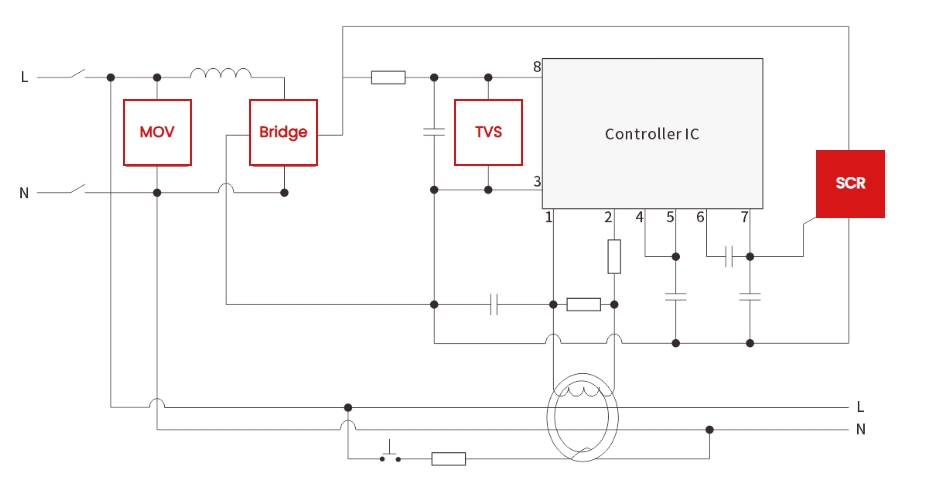
- MOV Varistor: Protecting AC Input Surges
When an abnormally high voltage occurs in the line, the MOV quickly reduces impedance, absorbs surge energy, and limits downstream voltage.
Recommended Model:
- 07D471K: 423-517V@1mA,1200A surge capability
- 10D561K: 504-616V@1mA,2500A surge capability
- 14D821K: 738-902V@1mA,4500A surge capability
- Bridge Rectifier: Provides stable DC power
RCD internal control circuitry typically needs to convert AC input to DC power.
Recommended Model:
- MB6F: 600V voltage rating, 0.8A forward current, low power consumption design
- TVS Diode: Protects sensitive electronic circuits
TVS diodes feature fast response and low clamping voltage, effectively protecting RCD internal control circuitry.
Mainly used in:
- Power control sections
- MCU interface
- Low-voltage electronic modules
Recommended Model:
- SMAJ6.5CA: 6.5V,400W
- SMBJ5.0CA:5.0V,600W
- SMF12CA:12V,200W
- SCR Thyristor: Enables fast tripping control
SCR thyristors have high reliability and fast switching capability, and can be used for tripping trigger control in RCDs.
Recommended models:
- MCR100-8: TO-92, 600V, 0.8A
- MCR100-8W: SOT-223, 600V, 0.8A
- MCR16: SOT-23, 600V, 0.8A
V. Reference Design for Residual Current Device Circuit Protection
Summary
RCDs play a crucial role in protecting personnel safety, but their internal electronic systems also need to withstand complex electrical environments.
By combining RCDs with semiconductor protection devices such as MOVs, TVSs, rectifier bridges, and SCRs, the surge protection, operational stability, and long-term reliability of RCD products can be effectively improved.
Semiware offers a variety of circuit protection solutions to help customers develop safer and more reliable leakage current protection and intelligent circuit breaking devices.
For professional component selection assistance, please contact Semiware.