In the electronics manufacturing industry, MSL (Moisture Sensitivity Level) is an often overlooked but crucial reliability indicator.
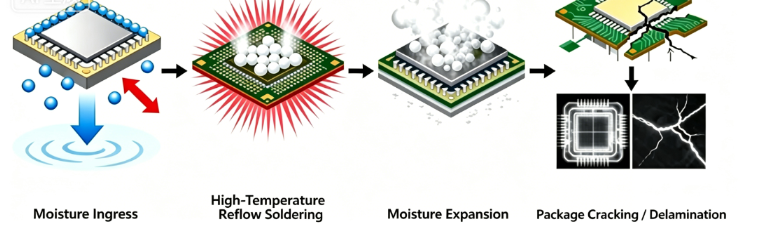
During SMT reflow soldering, if components absorb moisture, the high temperature causes the moisture to expand rapidly, leading to excessive package stress, delamination, cracking, or chip damage, directly impacting product performance and yield.
With the increasing prevalence of lead-free soldering processes and rising reflow peak temperatures, the importance of MSL management has become increasingly prominent. A few days ago, a European customer inquired about MSL levels, so today we'll systematically break down this core reliability indicator for electronic components.
I. MSL Overview
MSL is a humidity sensitivity level system defined by the JEDEC (J-STD-020) standard, used to measure the sensitivity of electronic components to ambient moisture.
Common MSL levels (MSL1–MSL6):
| MSL Level | Environmental Conditions | Floor Life | Handling Requirements |
| MSL 1 | ≤30°C / 85% RH | Unlimited | No special handling required |
| MSL 2 | ≤30°C / 60% RH | 1 year | Humidity control required after opening |
| MSL 3 | ≤30°C / 60% RH | 168 hours | Baking required if floor life is exceeded |
| MSL 4 | ≤30°C / 60% RH | 72 hours | Baking required if floor life is exceeded |
| MSL 5 | ≤30°C / 60% RH | 48 hours | Baking required if floor life is exceeded |
| MSL 6 | ≤30°C / 60% RH | 12 hours | Mandatory baking before use; components must be mounted immediately after opening |
The higher the MSL number, the higher the component's sensitivity to moisture, and the shorter the allowable exposure time to open environments.
II. Mechanisms of Moisture's Harm to Packaging
After a component absorbs moisture, the moisture remains trapped inside the package. During high-temperature reflow soldering, this moisture rapidly vaporizes:
- Internal pressure increases dramatically;
- Stress concentration occurs at the package interface;
- The package may delaminate, crack, or develop microcracks in the chip;
- Component electrical performance may degrade or fail.
In lead-free soldering processes, this risk is more pronounced due to the higher peak temperatures.
III. MSL Level Verification Process
MSL level determination requires standardized testing:
- Initial Inspection: Scanning Acoustic Microscopy (SAM) or X-ray confirms the package is defect-free;
- Baking and Dehumidification: Moisture is removed in an environment of 125°C ± 5°C;
- Moisture Absorption Treatment: Exposure to 30°C / 60% RH for 192 hours to simulate workshop moisture absorption;
- Reflow Soldering Simulation: Multiple reflow soldering cycles at a peak temperature of 260°C are performed;
- Final Inspection: Structural and electrical performance checks confirm compliance with level requirements.
Failure criteria include encapsulation delamination, excessive crack area, or critical parameters exceeding allowable ranges.
IV. Moisture Protection and Storage Strategies for Different MSL Levels
1. MSL1–MSL2: Low humidity sensitive components, can be stored long-term.
- Use a moisture-proof bag (MBB) + desiccant, controlling humidity ≤ 60% RH.
2. MSL3–MSL5: Medium to high humidity sensitive components
- Record the floor life after opening; re-baking is required if the floor life is exceeded.
- Use a humidity indicator card (HIC) to monitor component status.
- Storage recommendations: Temperature ≤ 30°C, humidity ≤ 40% RH.
3. MSL6: Extremely high humidity sensitive components
- Must be mounted immediately after opening; re-baking is required according to specifications if the floor life is exceeded.
V. Bake-out and Moisture Control Management Methods
📦 The Moisture Control "Trio"
- Moisture Barrier Bag (MBB)
- Desiccant
- Humidity Indicator Card (HIC)
🔥 Bake-out Recommendations
- Temperature: 125°C ± 5°C
- Duration: Adjust based on package thickness and MSL level.
- Specific protocols must be established for components packaged in reels and trays.
⏱ Floor Life Management
- Record the time of opening.
- Complete the mounting process within the allowable exposure time.
- If the allowable time is exceeded, a bake-out process is required.
- After baking, the exposure time clock may be reset.
Conclusion
Proper management of storage, moisture control, bake-out procedures, and floor life can significantly reduce package stress and functional failures caused by moisture, thereby enhancing overall production yield and product reliability.
Semiware designs and validates its products in strict compliance with industry standards. Select ESD protection devices, TVS diodes, and other circuit protection products offered by Semiware achieve an MSL 1 rating, providing customers with enhanced stability and reliability for their applications.
We invite you to explore Semiware's comprehensive range of circuit protection solutions, designed to provide your electronic products with superior protection against ESD, surges, and overcurrent events.
Learn More
👉 Welcome to visit our website or contact us to discuss selection guidelines and application solutions.