As electronic equipment becomes increasingly sophisticated and application environments more complex, lightning surges and transient overvoltages have become significant factors affecting system reliability. To ensure circuit safety, various surge protection devices are widely used in power interfaces, communication lines, and industrial control systems.
Among the many protection schemes, TVS (Transient Voltage Suppressor) and TSS (Thyristor Surge Suppressor) are the two most common types of parallel surge protection devices. Although both are used to protect circuits from high-energy transient impacts, their working mechanisms are quite different:
- TVS uses a clamping mechanism
- TSS uses a crowbar mechanism
Each technical approach has its advantages and corresponds to different application scenarios.
I. Core Logic of Parallel Protection
For high-energy transient events such as lightning surges and induced surges, the protection device needs to act quickly before the overvoltage reaches the sensitive load and safely release the surge energy.
Therefore, the core objectives of parallel protection schemes are:
- Fast response to overvoltage events
- Limiting voltage across the load
- Shunting inrush current
- Improving system reliability
TVS and TSS employ two different protection approaches to achieve this objective.
II. Two Protection Mechanisms: Clamping vs. Switching
- TVS: The Steadfast "Clamper"
TVS is a transient overvoltage protection device based on the avalanche breakdown effect of semiconductor PN junctions.
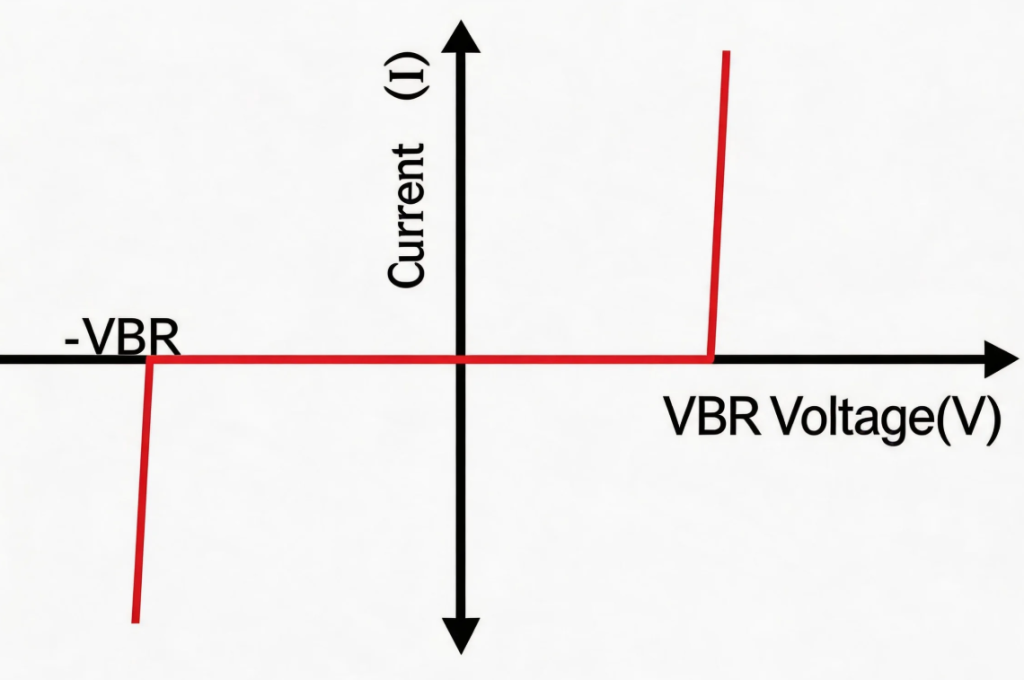
When the line voltage exceeds its breakdown voltage, the TVS quickly enters avalanche conduction mode, clamping the overvoltage within a preset range, thereby protecting downstream circuits from damage.
Key Features:
- Extremely fast response speed, typically less than 1ns
- Predictable clamping voltage
- Available for unidirectional and bidirectional devices
- Wide junction capacitance range to meet high-speed signal interface requirements
- Suitable for ESD, EFT, and Surge protection
Typical Products: SMAJ Series, SMBJ Series, SMCJ Series
- TSS: The Decisive "Switcher"
TSS (Thyristor Surge Suppressor) is based on a thyristor structure and is essentially a voltage-triggered switching device.
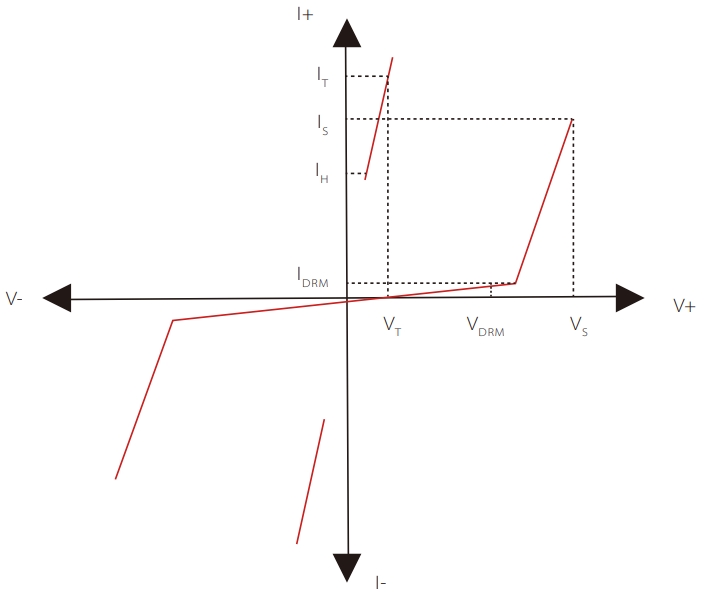
When the line voltage exceeds its breakover voltage (VBO), the TSS is rapidly triggered and enters a low-impedance conduction state, bypassing the surge current to ground, thus protecting downstream circuitry.
After the surge, when the current drops below the holding current, the device automatically returns to a high-impedance state.
Key Features:
- Nanosecond-level response speed
- Extremely low residual voltage after conduction
- Strong surge current withstand capability
- Extremely low leakage current
- Automatic recovery, no replacement required
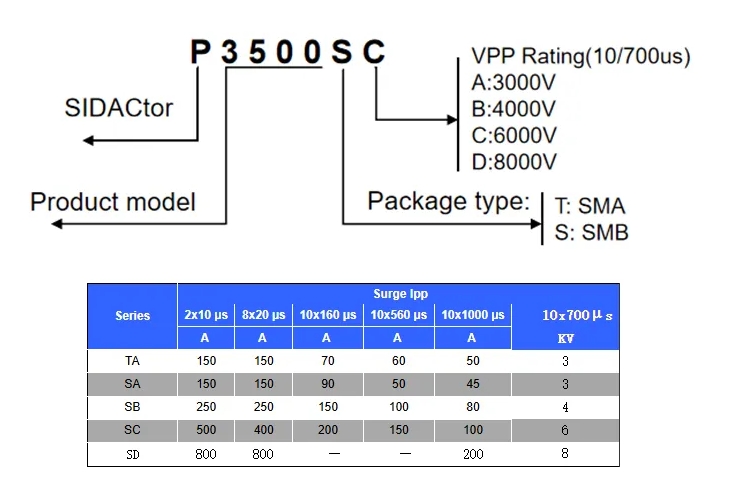
Typical Products: PxxxxS(A/B/C/D) Series
III. TVS vs TSS Operating Curves and Electrical Behavior
TVS: Current flows only during the clamping phase. A voltage (VcL) is always present across the device, resulting in high instantaneous power and heat generation.
TSS: "Fires" when the voltage reaches VBo. The voltage across the device is extremely low during conduction, resulting in minimal power dissipation and the ability to withstand larger inrush currents.
IV. Power and Efficiency: Why is TSS More Resilient?
Same Package, Different Capabilities.
TVS (e.g., SMBJ): Current-carrying capacity decreases significantly with increasing breakdown voltage (VBR). Higher voltage means lower current capacity. The maximum current capacity of SMBJ5.0CA is 10x1000 µs 60A.
TSS: Current-carrying capacity remains constant regardless of voltage rating. For example, the PxxxxSC series is 10x1000 µs 100A.
Conclusion: In high-voltage, high-current applications, TSS offers higher power density.
TSS Naming and Parameters:
V. Selection Guidelines: Choosing Between TVS and TSS
| Characteristic | TSS (Thyristor Surge Suppressor) | TVS Diode |
| Protection Mechanism | Crowbar Type | Clamping Type |
| Operatng Principle | Triggers at VBO and switches to a low-impedance state; on-state voltage remains very low (VT). | Enters avalanche conduction above VBR and clamps the voltage below VC. |
| Response Time | Fast (nanosecond range) | Extremely Fast (<1 ns) |
| Residual Voltage | Very Low | Limited by Clamping Voltage (VC), typically higher than TSS |
| Surge Current Capability | Excellent, suitable for high-energy surge environments | Moderate to High, suitable for most ESD, EFT and Surge protection applications |
| Capacitance | Low (typically tens to hundreds of pF) | Higher (typically hundreds to thousands of pF for SMBJ series) |
| Leakage Current | Extremely Low | Low |
| Typical Failure Mode | Predominantly short-circuit failure | Predominantly short-Circuit failure; some low-power devices may fail open-circuit |
| Key Advantages | Low residual voltage, high surge capability, low capacitance, long service life | Ultra-fast response, accurate clamping, broad application coverage |
| Typical Applications | RS-485, RS-232, Telephone Lines, xDSL, Industrial Communication Interfaces | Power Inputs, DC Ports, Industrial Control Systems, Power Adapters |
Conclusion
TVS and TSS each have their advantages. TVS is responsible for quickly clamping overvoltage, while TSS is responsible for efficiently dissipating surge energy.
By rationally utilizing the advantages of both and constructing a hierarchical and coordinated protection system, more reliable safety guarantees can be provided for electronic equipment in complex electromagnetic environments.
Contact Us
Semiware offers a complete product line of TVS and TSS devices, providing professional circuit protection solutions for applications such as industrial control, communication equipment, power systems, and consumer electronics. We welcome you to discuss your project needs with us.