Overview
In many small electronic devices, transistors do not handle complex power conversion; instead, they perform fundamental tasks such as controlling small loads, amplifying sensor signals, powering peripherals, or providing simple level control.
Focusing on practical circuit applications, this article introduces the key parameters of the S8550, the role of PNP transistors in circuits, common use cases, and the differences between the S8550 and the S8050.
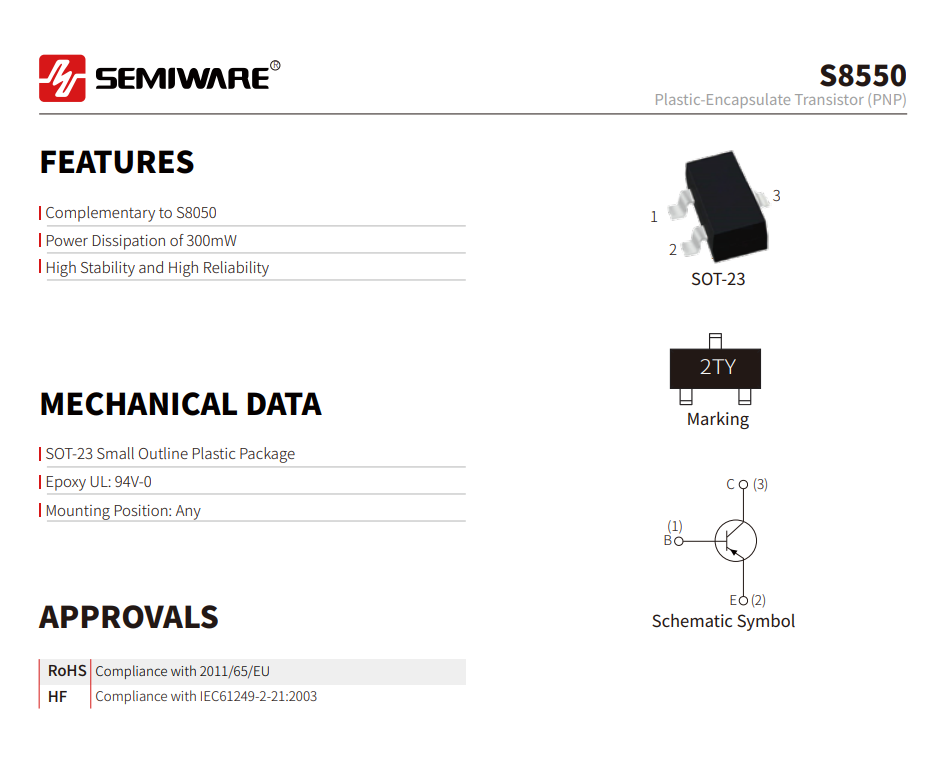
I. What is the S8550 Transistor? Key Parameters
The S8550 is a general-purpose PNP bipolar junction transistor (BJT) housed in an SOT-23 surface-mount package. It is suitable for applications such as switching, signal amplification, and signal conditioning.
Key Parameters of the Semiware S8550 Transistor:
| Parameter | Specs |
| Transistor Type | PNP |
| VCBO | −40 V |
| VCEO | −25 V |
| VEBO | −5 V |
| IC | −500 mA |
| hFE | 120–400 |
| fT | ≥150 MHz |
| TJ | −55°C to +150°C |
II. The Role of PNP Transistors in Circuits
The S8550 is positioned between the positive power supply rail and the load. When the S8550's emitter is connected to the positive supply, the transistor remains in the "off" state if the base voltage is close to the emitter voltage; however, when the base voltage drops sufficiently to forward-bias the base-emitter junction, the S8550 begins to conduct.
Consequently, PNP transistors are a convenient choice for circuits requiring control of the positive supply side of a load.
III. Common Applications of the S8550
3.1 LED and Lighting Control
- The S8550 can serve as a high-side switch in circuits controlling LED indicators, ambient lighting, and small-scale lighting systems.
3.2 Sensor Modules
- Sensors and small modules do not always need to be active. The S8550 can control the power supply to these modules, cutting off power during standby mode.
3.3 Smart Devices (e.g., Robot Vacuums, Access Control Systems)
- In these products, the S8550 can handle functions such as small-load switching, signal control, or peripheral power supply.
3.4 Signal Amplification
- Beyond switching applications, the S8550 can also be used for small-signal amplification.
3.5 Forming a complementary circuit with the S8050
The S8550 and S8050 can form a PNP/NPN complementary pair for use in:
- Level control
- Bidirectional driving
- Low-power signal amplification
IV. S8550 vs. S8050
The S8050 and S8550 frequently appear together in small electronic devices. The S8050 is an NPN transistor and the S8550 is a PNP transistor; together, they form a classic complementary transistor pair.
While the S8050 is more commonly used for low-side switching, a typical application for the S8550 is high-side switching—where the transistor is placed on the positive supply rail, and the base is controlled to determine whether power is delivered to the load.
V. S8550 Replacement and Engineering Design Recommendations
5.1 Key Parameters to Check When Replacing
- hFE range and classification
- VCE(sat)
- VBE(sat)
- Package
- Pinout
- Power dissipation
- Temperature range
5.2 Pinout
The Semiware S8550 uses the SOT-23 package with the following pin assignments:
- Pin 1 = Base
- Pin 2 = Emitter
- Pin 3 = Collector
5.3 Note hFE Classifications
The Semiware S8550 is available in three hFE grades:
- L: 120–200
- H: 200–350
- J: 300–400
5.3 Note Power Dissipation
The maximum power dissipation (PC) of the S8550 is 300 mW; appropriate derating should be applied for products intended for continuous operation.
Actual power dissipation should be determined based on the following parameters:
- Collector current
- VCE
- Ambient temperature
- PCB heat dissipation
- Package thermal resistance
5.4 Consider Reverse Voltage for Inductive Loads
- If the S8550 is used to drive inductive loads such as relay coils, the coil will generate a reverse induced voltage upon turn-off.
- In such cases, appropriate flyback or clamping protection should be added based on the circuit topology to prevent transient voltages from exceeding the transistor's voltage rating.
Summary
For projects requiring S8550 sample verification, BOM substitution, or volume procurement, Semiware provides product documentation, samples, and technical support to help confirm the device's suitability for the specific application.