I. Overview
During the deployment and maintenance of diagnostic imaging equipment (such as CT, MRI, DR, DSA, and mammography systems), surges and electrostatic discharge (ESD) are two frequent and highly destructive sources of electrical interference. They often cause image artifacts, circuit board damage, system downtime, and even the total failure of X-ray tubes or detectors.
II. Equipment Characteristics
Diagnostic imaging equipment is characterized by a combination of high-voltage/high-power modules, low-level analog detector signals, and high-speed digital links. The systems involve extremely high capital costs, and downtime results in massive financial losses. Furthermore, the high-voltage generator itself acts as a strong source of interference, creating a scenario where internal and external interference sources overlap.
III. Mandatory Industry Standards
IEC 60601-1-2 (YY 0505) covers electromagnetic compatibility for medical electrical equipment; diagnostic imaging equipment must comply with the immunity levels specified therein.
IV. Sources and Risks of Electrostatic Discharge (ESD)
- Sources of Static Electricity Generation
Human Contact
In dry environments, static electricity is generated when medical staff or patients walk on insulating flooring, move examination tables, or touch touchscreens, metal equipment casings, or control buttons. The human body can accumulate a static charge of up to 15 kV.
Triboelectric Charging (Friction)
Static charges accumulate due to friction from the rotation of CT gantries, the movement of DR flat-panel detectors, the sliding of examination tables, and the dragging of cables.
Environmental Factors
Dehumidification by air conditioning systems in imaging rooms and low humidity during winter (static electricity accumulates very easily when humidity is below 40% RH). 2. Primary Intrusion Paths
Direct discharge: Touchscreens, control panels, exposed metal device casings, and connector housings (USB, Ethernet ports, maintenance serial ports).
Indirect coupling: Radiated electromagnetic fields from electrostatic discharge (ESD) coupling into internal detectors and low-level signal cables.
- Typical Vulnerable Components
Touchscreen controllers and keypad matrix ICs (CMOS technology is highly susceptible to ESD).
Detector front-end ASICs and photodiode arrays.
Serial/Ethernet PHY chips and electrical interfaces of fiber-optic modules.
Flat-panel detector (DR) surfaces: Dielectric breakdown of the ITO layer resulting in clusters of dead pixels.
V. Surge Sources and Risks
- Sources of Surges
Externally induced surges
Lightning-induced surges: High-voltage transients induced in power distribution lines by distant lightning strikes, entering the device via L/N/PE lines.
Upstream switching operations: Operational overvoltage caused by closing circuit breakers in hospital distribution rooms or starting/stopping heavy loads (e.g., elevators, HVAC units).
Poor mains power quality: Insufficient transformer capacity in older hospital wings, neutral-to-ground voltage shift, severe harmonics, and superimposed voltage spikes.
Internally coupled surges
Inductive load back-EMF: Voltage spikes generated when internal high-voltage generators, motors, or relays are switched off.
UPS switching transients: Millisecond-level voltage fluctuations occurring during the transition between bypass and inverter modes in online UPS systems.
Poor grounding systems: Excessive grounding resistance or shared grounding networks preventing effective surge dissipation, leading to transverse coupling into the signal chain. 2. Components Typically Susceptible to Damage
Power supply modules, rectifier bridges, DC/DC converters
Data Acquisition System (DAS) front-end amplifier circuits
Console network interface cards (NICs), graphics cards, and motion control cards
X-ray tube drive high-voltage inverter boards (similar components are found in CT/MRI gradient cabinets)
VI. Semiware’s Surge and ESD Protection Solutions
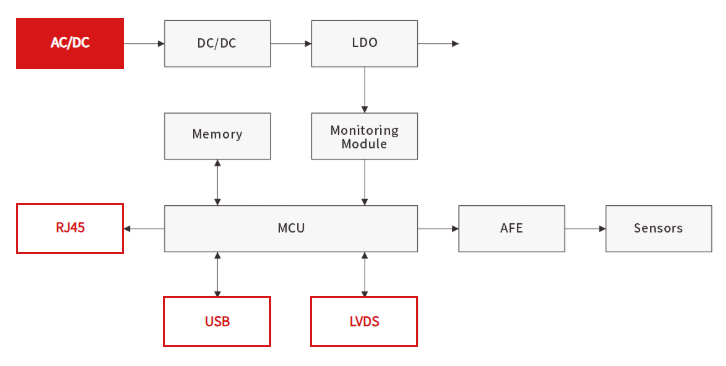
Learn More
To learn more about common surge and ESD risks and solutions for diagnostic imaging equipment, please visit: https://en.semiware.com/applications/radiography/