In actual use of electric bicycles, the BMS (Battery Management System) often faces some "hidden but high-frequency" problems, such as:
Communication abnormalities after plugging and unplugging the charger
CAN/RS-485 communication interruption in humid environments
System reset or malfunction after human contact
The root cause of these problems is often not the control algorithm, but the damage to the circuit caused by electrostatic discharge (ESD) and surge impacts.
I. Main Risks of ESD and Surges to BMS
- Damage to Precision Components
Electrostatic discharge is easily generated or introduced during riding, charging, and plugging and unplugging interfaces in electric bicycles.
The MCU, AFE, and power management chip inside the BMS are extremely sensitive to ESD. Transient high voltage can directly break down the internal structure, leading to:
- Permanent functional failure
- Abnormal system restart
- Partial module damage
- Communication System Abnormalities (CAN/RS-485)
The BMS needs to communicate with the motor controller and charger.
When ESD or surges enter the communication lines, it can lead to:
- Data errors/packet loss
- Bus congestion
- Communication interruption
- Ultimately affecting battery SOC determination and vehicle control safety.
- Amplified safety risks (overcharge/over-discharge runaway)
If the protection circuit fails due to ESD, the BMS may fail to perform the following correctly:
- Overcharge protection
- Over-discharge protection
- Overcurrent protection
In extreme cases, this may cause battery overheating or even thermal runaway.
II. BMS ESD/Surge Protection Design Strategy
- Grounding Design: Establishing a Low-Impedance Discharge Path
Design considerations include:
- Complete large-area ground plane on the PCB
- Reliable connection of the BMS housing to the chassis
- Using conductive pads/metal screws to enhance contact reliability
- Shielding Design: Reducing External Coupling Interference
For highly sensitive signals (communication/sampling lines):
- Use shielded twisted-pair cable (shielding layer grounded at one end)
- Sensitive areas of the PCB are surrounded by ground copper
- Physical isolation between strong and weak current areas
- Protection Design for Key Components
(1) TVS Diode: Core of Power Supply and Interface Surge Protection
TVS diodes are used to absorb transient surge energy and are most commonly found at power input terminals and communication ports.
For example, in a 48V system, TVS devices such as SMDJ58CA can be used for:
- Power input surge absorption
- High-energy transient clamping protection
Its characteristics include fast response speed, capable of conducting in nanoseconds, discharging surge current to ground.
(2) ESD Diode: Protects high-speed signal interfaces
Used to protect low-capacitance sensitive interfaces, such as:
- Buttons
- Communication IO
- CAN / RS-485 signal lines
For example, devices such as SD05C have the following characteristics:
- Ultra-low capacitance
- Fast response
- Minimal impact on signals
(3) Varistor (MOV): Absorbs high-energy surges
In power supply entry level protection, MOV is usually used in conjunction with TVS:
- MOV: Absorbs large energy surges
- TVS: Fast and precise clamping
However, MOV has aging issues and its lifespan needs to be evaluated in reliability design.
III. PCB Layout and Routing Optimization
- Shorten sensitive signal paths
- Reduce parasitic inductance and induced charge accumulation, improving anti-interference capabilities.
- Strong and weak current zone design
- Power zone (motor, power supply)
- Signal zone (MCU, communication)
- Isolated by a ground plane
- Decoupling Capacitor Design
- Place decoupling capacitors appropriately near the chip's power supply pins, such as a combination of 0.1μF and 10μF capacitors, to suppress transient voltage fluctuations.
V. Case Study: RS-485 Communication Interface Surge Damage Analysis
A batch of electric bicycles experienced BMS communication failures:
Symptoms:
- 485 communication interruption
- Partial chip burnout
- Abnormal charging/riding status
Improvement Solution:
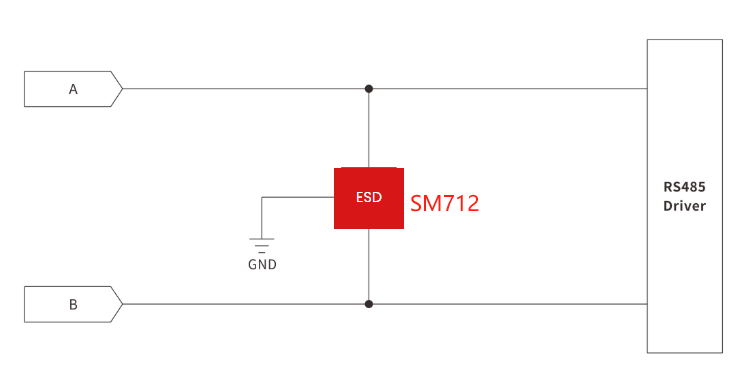
- Add RS-485 protection device - SM712 TVS array
- Supports -7V ~ 12V asymmetrical operating voltage
- Withstands IEC 61000-4-2 ±30kV ESD
- Has 8/20μs surge current absorption capability
- Effectively protects the RS-485 transceiver from transient impacts.
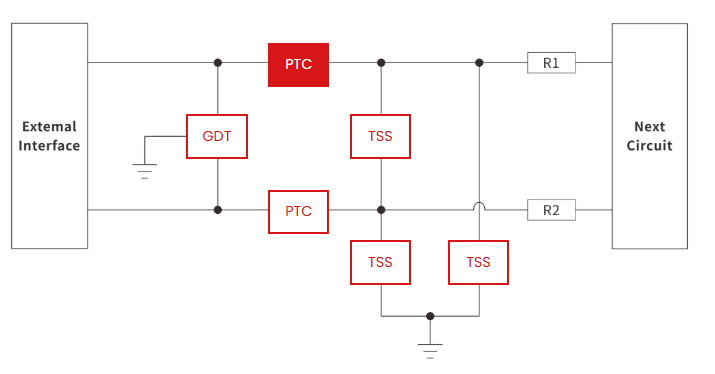
- Added Overcurrent Protection - PPTC Resettable Fuse
- Abnormal Current → Rapid Resistance Increase
- Automatic Reset After Fault Resolution
- Forms a Resettable Protection Structure
- PCB Optimization
- Dedicated RS-485 Trace Area
- Added Ground Shielding Copper Pad
- Avoid Proximity to Power Supply and Switching Nodes
Summary
The reliability of an electric bicycle BMS depends not only on the control algorithm but also on the adequacy of its ESD and surge protection design.
A mature design typically requires:
- Grounding (Basic)
- Shielding (Isolation)
- Components (TVS / ESD / MOV)
- PCB Layout Optimization (System-Level Protection)
Through system-level protection design, the stability and safety of the BMS in real-world complex environments can be significantly improved.