Introduction
The application scenarios for industrial and commercial drones continue to expand—ranging from surveying, inspection, and agricultural crop protection to heavy-lift logistics models. Battery configurations vary widely, with 3-cell to 16-cell lithium-ion packs being the standard.
Different drone models impose distinct, rigorous requirements on power systems:
- Ultra-low standby power consumption to minimize energy loss during storage;
- High-efficiency power topologies to reduce thermal stress and simplify the drone's overall thermal management design;
- Charging systems compatible with a wide power range (100W–1000W) to support fast-charging scenarios.
However, as aerial equipment, drones are highly susceptible to severe accidents—such as crashes or fires—triggered directly by electrical faults on the power system side.
 ESD-and-Surge-Protection-Reference-Solution.jpg" alt="For 3–16 Cell Lithium-Powered Drones: Identifying Electrical Risks and Building Reliable Power Protection Architectures" title="For 3–16 Cell Lithium-Powered Drones: Identifying Electrical Risks and Building Reliable Power Protection Architectures" alt="UAV ESD and Surge Protection Reference Solution
" class="wp-image-18606" style="width:579px;height:auto"/>
ESD-and-Surge-Protection-Reference-Solution.jpg" alt="For 3–16 Cell Lithium-Powered Drones: Identifying Electrical Risks and Building Reliable Power Protection Architectures" title="For 3–16 Cell Lithium-Powered Drones: Identifying Electrical Risks and Building Reliable Power Protection Architectures" alt="UAV ESD and Surge Protection Reference Solution
" class="wp-image-18606" style="width:579px;height:auto"/>I. Key Electrical Risks in Drone Power Systems
1.1 Risks of Cell Overcharge, Over-discharge, and Cell Imbalance
In battery packs with 3 to 16 cells in series, voltage drift occurs due to manufacturing tolerances and varying aging rates among individual cells. During charging, overvoltage in a single cell can trigger lithium plating and swelling, potentially leading to thermal runaway in extreme cases.
During flight discharge, if a specific cell reaches undervoltage prematurely, the system's power supply may drop, causing a sudden loss of propulsion in mid-air. In a series architecture, an anomaly in a single cell compromises the safety and usable capacity of the entire battery pack.
1.2 Overcurrent and Short-Circuit Surges During Charge/Discharge
- Rapid acceleration or braking of drone motors generates high instantaneous currents;
- Motor stalls, cable abrasion, and water or dust ingress in connectors create risks of circuit short-circuits;
- High currents rapidly raise the temperatures of MOSFETs, wiring harnesses, and cells, potentially causing component burnout or even battery fires within a short period;
- In high-power charging scenarios (100–1000W) for heavy-lift models, overcurrent in the charging circuit is also a frequent risk factor.
1.3 Heat Generation in Power Components and Thermal Cascade Risks
- During high-power charging and discharging, power losses occur in BMS switching components, charging topology circuits, and Electronic Speed Controllers (ESCs). Inadequate conversion efficiency generates significant excess heat;
- Heat accumulation within the drone's compact body easily creates localized hot spots. This not only accelerates component aging but also transfers heat to the battery pack, potentially triggering thermal runaway—a risk that is further amplified by insufficient thermal design, particularly during high-power fast charging.
1.4 Hidden risks associated with excessive standby power consumption
During long-term storage or transport, high standby power consumption by the BMS and peripheral circuits can gradually drain the battery into an undervoltage state. Deep over-discharge causes permanent damage to the battery cells, rendering the battery unusable and creating safety hazards during subsequent recharging.
1.5 Risks involving surges, static electricity, and interface EMI
- Inrush surges occur the moment the battery is connected or disconnected;
- Static electricity is a significant factor in high-altitude and outdoor environments;
- High-power switching in motors and electronic speed controllers (ESCs) generates electromagnetic interference (EMI).
Such interference can distort sampling signals, trigger protection chips erroneously, and disrupt communication, leading to either false protection cut-offs or protection system failure.
II. Protection Design Strategy for 3–16 Cell Lithium-Battery Drones
- AC Input Port Protection
Designed for the AC input ports of external chargers, this protection shields against grid surges, lightning strikes, and high-voltage spikes caused by plugging/unplugging the charger. It blocks high-voltage interference from propagating to downstream AC/DC stages and the battery link, serving as the first hardware barrier for high-power (100–1000W) charging.
Selected Components:
SG2R08B600A Gas Discharge Tube (GDT)
Specifications: 8.3×8.3×6.0mm, 600V, 20kA; handles the discharge of high-energy lightning surges;
Paired with 14D561K Metal Oxide Varistor (MOV)
Specifications: 460V operating voltage, 50A, 360pF; absorbs differential-mode surges on the AC side; the combination of these two components provides robust surge protection for the AC input.
2. Battery Port Protection
Provides ESD and transient surge protection for external battery ports, mitigating voltage spikes caused by hot-swapping and cable vibration.
Selected Components:
SE10F80U4.5A and SE10F10B5.0A ESD diodes; these absorb electrostatic discharge (ESD) and voltage spikes during battery connection/disconnection, protecting downstream power paths from transient surge damage.
- Wired Communication: RS485 Interface Protection
RS485 is commonly used for long-distance communication between drone batteries, flight controllers, and ground stations. It is highly susceptible to ground potential differences, ESD, and surge interference, which can lead to communication errors or even MCU burnout.
Selected Components:
SE41T06U5.0LB (SR05) TVS diode array
Provides symmetrical ESD and surge clamping for RS485 differential A/B lines. Low parasitic capacitance ensures differential signal integrity and suppresses common-mode interference introduced by long cables, protecting the bus from high-voltage spike breakdown.
- Wireless Link: Antenna Port Protection
High-altitude operating environments feature significant static electricity, and antennas can couple with electromagnetic pulses in the air. ESD can easily damage RF chips, causing wireless link failure. Protection components must balance ESD dissipation with RF performance to avoid degrading antenna signals.
Selected Components:
SE10F10B5.0UA low-capacitance ESD diode (0.25pF ultra-low capacitance); dissipates ESD surges while having virtually no impact on data transmission.
- USB Interface Protection
USB ports used for debugging, video transmission, and peripheral expansion are prone to risks from hot-swapping and human-body ESD during outdoor use; faults could potentially back-feed and damage the system's power domain.
Selected Components:
SE10F10B5.0A ESD diode; provides ESD protection for USB data lines, suppressing ESD surges caused by hot-swapping and protecting USB peripherals and the main control power domain.
6. ESD Protection for Audio and Touch Button Interfaces
Touch buttons and audio signal paths are exposed on the device enclosure; contact by operators can introduce significant electrostatic discharge (ESD). This discharge can cause false button triggering and audio noise, or—in severe cases—trigger a system reset or damage the MCU I/O ports.
Recommended Component:
SE23T40B712B (SM712) TVS diode array. This component provides unified ESD discharge for multiple I/O lines and is suitable for audio and touch button signal circuits, preventing ESD-induced false triggering, audio noise, and damage to the main controller's I/O ports.
III. Semiware UAV ESD and Surge Protection Reference Solution
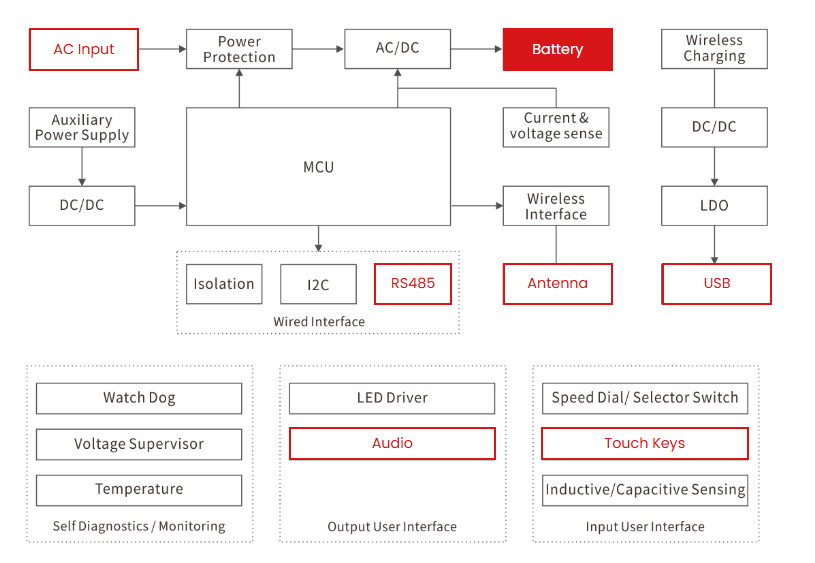 ESD and Surge Protection Reference Solution
" class="wp-image-18605"/>
ESD and Surge Protection Reference Solution
" class="wp-image-18605"/>For more details, please visit: https://en.semiware.com/applications/uav
Conclusion
For UAVs using 3–16S lithium-ion battery packs, reliable power protection requires more than a single protection device. Battery voltage, charging power, switching transients, thermal stress, standby current, ESD, and surge events all need to be considered as part of the overall circuit design.
Please feel free to contact our technical staff to discuss your application requirements.