I. What is PoE?
PoE (Power over Ethernet) is a technology that enables the simultaneous transmission of both data and electrical power over a single network cable. Compared to traditional devices—which require the separate routing of power cables—PoE technology significantly reduces cabling complexity, improves installation efficiency, and lowers maintenance costs.
Currently, PoE is widely applied in the following areas:
- Network Cameras (IP Cameras)
- Wireless Access Points (Wireless APs)
- IP Phones
- Smart Access Control Systems
- Industrial Networking Equipment
However, in outdoor environments, PoE interfaces are constantly exposed to lightning strikes, power surges, and electrostatic interference; therefore, the protective design of these interfaces requires particular attention.
II. What Risks Do Outdoor PoE Interfaces Face?
1. Lightning Surges
Long-distance outdoor network cables are susceptible to induced energy from lightning strikes. These instantaneous, high-voltage surges can directly damage the following components:
- PHY Chips
- PoE Power Supply Modules
- MCUs
- Network Transformers
In severe cases, this can even lead to the complete failure of the entire device.
2. Electrostatic Discharge (ESD)
In dry environments or during the process of connecting and disconnecting devices, PoE RJ45 interfaces are vulnerable to electrostatic shocks.
ESD can result in:
- Network Disconnections
- Packet Loss
- Communication Anomalies
- Chip Damage
3. High-Frequency Signal Integrity Issues
PoE network ports simultaneously carry high-speed differential signals; therefore, protective components must possess the following characteristics:
- Ultra-Low Capacitance
- Low Insertion Loss
- Excellent High-Frequency Characteristics
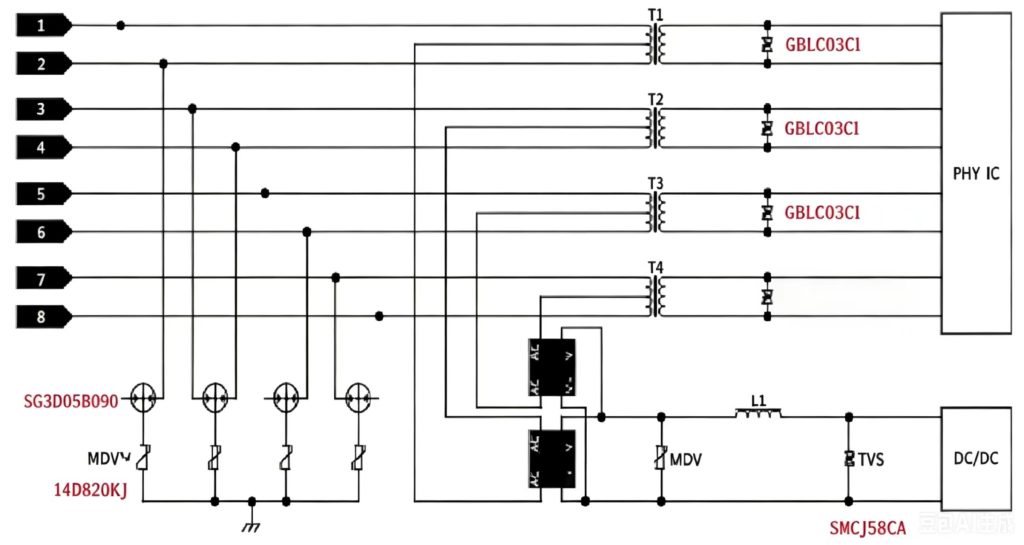
To address this challenge, we have introduced an outdoor PoE surge protection solution featuring a two-stage protection architecture capable of withstanding 6kV surges.
III. Semiware’s Outdoor 6kV PoE Protection Solution
1. Solution Overview
This solution employs a combination protection strategy to effectively reduce the surge voltage imposed on downstream chips.
Stage 1: GDT + MOV — Diverting and dissipating high-energy surges.
Stage 2: TVS + ESD — Providing a second stage of fine-grained clamping protection.
2. Test Standards
ESD Protection Level:
IEC 61000-4-2 — Contact Discharge: ±30kV; Air Discharge: ±30kV
Surge Protection Level:
IEC 61000-4-5 — 10/700µs waveform, 40Ω impedance, 6kV
3. Recommended Protection Components
| Part Number | Device Type | Key Specs | Main Advantages |
| GBLC03CI | ESD Diode | SOD-323, 3.3V, 0.6pF, ±30kV, 20A | Ultra-low capacitance for high-speed Ethernet |
| SG3D05B090 | Gas Discharge Tube | 90V, 5kA, 1.5pF, 2-channel | High surge capability with low capacitance |
| 14D820K | Varistor | 82V, 6kA | Excellent high-energy surge absorption |
| SMCJ58CA | TVS Diode | 58V, 1.5kW, 16.1A | Fast clamping response for secondary protection |
IV. Typical Applications
This solution is ideal for:
- Outdoor IP Cameras
- PoE Switches
- Wireless Access Points
- Smart City Surveillance
- Industrial Ethernet Systems
- Security Monitoring Equipment
Conclusion
With the widespread adoption of PoE technology in security and industrial networking applications, the risks associated with lightning strikes and ESD in outdoor environments are receiving increasing attention. A well-designed multi-stage protection scheme not only enhances device reliability but also significantly reduces long-term maintenance costs.
Semiware offers a comprehensive portfolio of ESD, TVS, GDT, and MOV protection devices, enabling engineers to quickly implement highly reliable protection designs for PoE interfaces.
For complete PoE protection circuit schematics, device selection guidance, or sample support, please feel free to contact Semiware.