AC slow charging stations (mainly 7kW) connect to the 220V mains power grid on one side and to the vehicle's OBC charger, VCU, and BMS via a charging gun on the other. The entire system is divided into four main areas: high-power circuit (L/N/PE), control signal circuit (CP/CC guidance), human-machine interaction (touchscreen, buttons), and communication (CAN/4G/WiFi). Surges and static electricity can intrude along different paths, causing minor malfunctions or, in severe cases, burning out the charging station and vehicle's electronic control system. National standards GB/T 17626 and NB/T 33002 mandate immunity indicators.
I. Surge (Lightning Strike/Power Surge) Risks
- Sources of Surges
- Lightning Surges (Most Critical): Direct lightning strikes are rare; induced lightning accounts for over 90%. Outdoor charging piles and long-distance power lines in garages act like antennas; lightning strikes within 2km can generate 1.2/50μs high-voltage surges on phase lines through electromagnetic coupling. In the Yangtze River Delta and South China regions, which are prone to lightning strikes, induced surge voltages can easily exceed 4kV. Dense cables in underground garages can also cause induced overvoltages.
- Grid Operational Overvoltages: The opening and closing of transformers in residential areas, the starting and stopping of high-power air conditioners/compressors, and the switching on and off of circuit breakers in distribution boxes generate repetitive switching surges. Aging power distribution systems and neutral wire drift in residential areas can continuously accumulate transient high voltages.
- Load Switching Disturbances: The simultaneous starting and stopping of multiple charging piles in a group causes drastic changes in circuit current, resulting in reverse voltage spikes due to cable inductance.
- National Standard Mandatory Surge Test Level (GB/T 17626.5)
- AC power port: Common mode ±4kV, Differential mode ±2kV (1.2/50μs)
- CP, CC, CAN and other signal lines: ±2kV surge
- Waveform: Voltage 1.2/50μs, Current 8/20μs. Commercial charging piles are required to function normally after impact and not be permanently damaged.
- Surge Intrusion Path and Damage Consequences
(1) AC High Voltage Circuit (L/N/PE)
Intrusion Path: Mains power input → EMI filter → Switching power supply, relay, main control power supply board
Fault Phenomena:
- Fuse blown, rectifier bridge, switching power supply MOSFET broken down, the whole machine cannot be powered on;
- Varistor exploded, PCB copper foil burned out due to overcurrent;
- When grounding is poor, the surge enters the PE line, is conducted along the charging gun into the vehicle, and breaks down the vehicle OBC power port and BMS. Sampling chips, and even the power battery acquisition board, can be damaged.
(2) CP/CC Guide Signal Lines (Most Prone to False Protection)
AC charging relies on CP (Control Guide) and CC (Connection Confirmation) to achieve vehicle handshake, current limiting, and emergency stop judgment. Surge coupling into thin wires:
- CP voltage is raised by the surge, the charging pile determines a vehicle fault, frequently trips the charging gun, and stops charging;
- CC misidentifies the charging gun head as detached, causing repeated start-stop charging;
- The main control MCU IO port is damaged by high voltage, and the entire vehicle cannot be recognized.
(3) Communication Lines (CAN, 4G)
CAN bus surge interference causes message garbled characters: BMS and charging pile communication interruption, abnormal power limiting, and billing errors; the 4G module RF port is damaged by the surge, resulting in network failure.
II. Static Electricity Discharge (ESD) Risks
- Causes of Static Electricity Generation
Dry autumn and winter, and low humidity environments in northern regions are the most severe causes; human contact with the metal charging gun head, touchscreen, and metal casing parts; friction between the charging gun and the insulating layer generates static electricity; static charge accumulates on garage carpets and tires rubbing against the vehicle body, and is discharged instantly upon charging gun connection.
National Standard ESD Requirements: Contact discharge ±6kV, air discharge ±8kV; High-end household charging stations often have higher standards: Contact ±8kV, Air ±15kV.
- Three Paths of Static Electricity Intrusion
- Direct Contact Discharge: Touching the metal terminals of the charging gun head, the metal casing, or the touchscreen frame directly conducts static electricity to the PCB power supply/IO;
- Air Discharge: Fingers near the screen or indicator light gaps cause an electric arc to reach internal traces;
- Coupling Crosstalk: Static electricity creates an electric field in the chassis, interfering with nearby weak signal lines, interfering with chips without physical contact.
- Typical Static Electricity Faults (by Module)
- Main Control MCU Crash/Reboot
ESD entering the main control power supply or reset pin causes the charging station screen to go black, timer to reset, charging to restart mid-charge, and charging progress to be lost. - CP/CC Signal Malfunction**
Static electricity hitting the guide wires causes the charging station to repeatedly identify "no gun inserted," resulting in intermittent charging. Users may mistakenly believe the charging gun wires are damaged. - Touchscreen Malfunction
Static interference to the screen touch IC causes unresponsive touch, random button presses, and screen flickering. - Damage to Vehicle-Mounted Terminals
When the charging gun is conducting, static electricity bridging the vehicle-mounted charging station can damage the vehicle's VCU and CAN transceiver, resulting in a charging fault code for the entire vehicle. - Latent Soft Faults
Static electricity does not immediately burn out hardware, but it causes a chip latch-up effect, leading to intermittent faults over long-term use that are difficult to reproduce and troubleshoot.
III. Surge and ESD Protection Solutions from Semiware
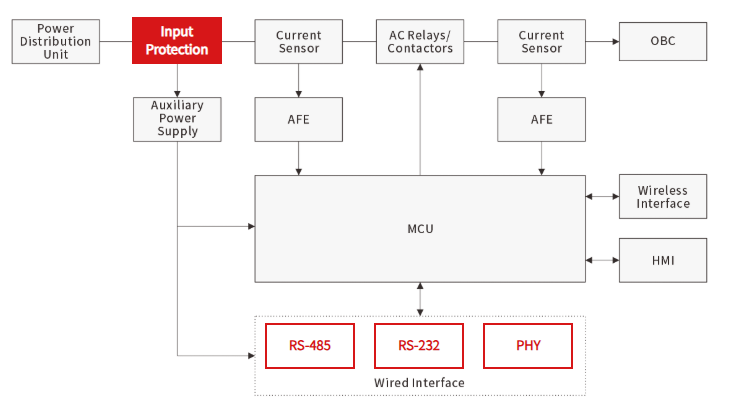
For more details on surge and ESD protection solutions for AC charging stations, please visit: https://en.semiware.com/applications/ac-charger/