Introduction
The S8050 is a widely used general-purpose NPN bipolar junction transistor (BJT) in electronic circuits, commonly employed in low-power switching, signal amplification, and control applications. However, during the component selection process, variations may exist among S8050 devices from different manufacturers regarding hFE classification, saturation voltage, pinout, packaging, and specific electrical parameters.
Semiware’s S8050 aligns with industry standards regarding pinout and packaging. This article provides a detailed analysis covering key parameters, operating principles, applications, replacement selection, and engineering design considerations.
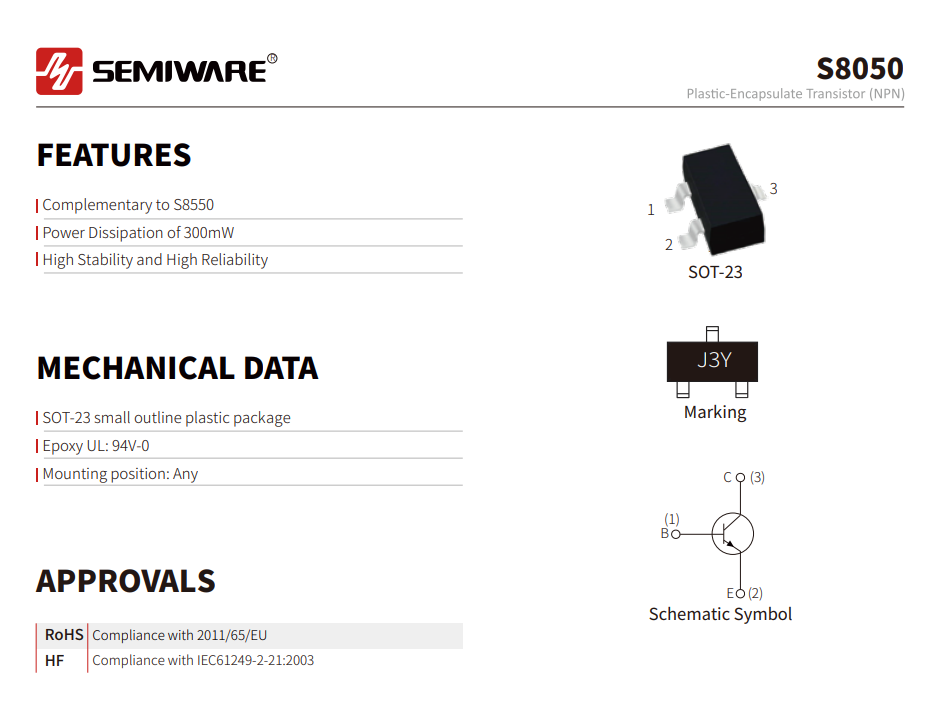
I. Key Parameters of the S8050 Transistor
| Parameter | S8050 |
| Transistor Type | NPN |
| Package | SOT-23 |
| Collector-Base Voltage (VCBO) | 40 V |
| Collector-Emitter Voltage (VCEO) | 25 V |
| Emitter-Base Voltage (VEBO) | 5 V |
| DC Current Gain (hFE) | 120–400 |
| RoHS | Compliant |
II. How Does the S8050 Transistor Work?
The S8050 controls a large collector current using a small base current, making it suitable for both switching control and signal amplification.
Depending on the specific circuit configuration, the S8050 typically operates in one of two modes:
2.1 S8050 as a Switch:
In switching circuits, the S8050 is often configured as a low-side switch. Common applications include:
- LED indicator control
- Seven-segment display driving
- Relay driving
- Sensor interfacing
- MCU peripheral control
- Small load switching
2.2 S8050 as an Amplifier:
The S8050 can also be used in small-signal amplification circuits. Common applications include:
- Sensor signal amplification
- Small-signal audio circuits
- Signal conditioning
- General-purpose amplification circuits
When designing amplification circuits, one must not focus solely on hFE; factors such as the biasing network, operating point, collector current, and temperature variations must also be comprehensively considered.
III. Typical Applications of the S8050 Transistor
Designed for low-voltage, small-signal switching and amplification circuits, the S8050 transistor is primarily used in the following areas:
- LED indicator and seven-segment display driving;
- Small relay and buzzer driving (inductive loads);
- Sensor signal amplification and MCU peripheral logic switching;
- Auxiliary control circuits for small home appliances, remote controls, and power supply boards;
- Paired with the S8550 to form a push-pull amplification circuit;
- Small-signal switching for IoT modules and industrial control boards.
IV. S8050 Pinout and Replacement Analysis
The Semiware S8050 utilizes the SOT-23 package:
Pin 1: Base
Pin 2: Emitter
Pin 3: Collector
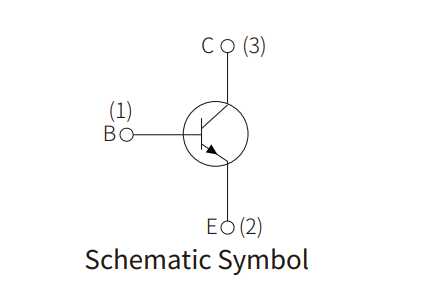
When replacing the S8050 with a version from another manufacturer, in addition to the pinout, it is essential to verify key parameters—such as VCEO, IC, hFE, VCE(sat), power dissipation, and temperature range—and to validate the component within the actual circuit.
V. Engineering Design Considerations and Recommendations
- Derating Design: Do not operate at the maximum rated collector current (IC); power dissipation (PC) must be derated as the ambient temperature rises.
- hFE Classification: The S8050 comes in B, C, and D gain grades; specify the required grade during procurement to avoid circuit operating point shifts caused by gain variations between batches.
- Base Resistor Calculation: For switching applications, select an appropriate base resistor to ensure the transistor reaches reliable saturation; avoid insufficient base current that could cause the transistor to enter the active (linear) region, resulting in switching failure.
- Inductive Load Protection: When driving inductive loads such as relays or buzzers, a flyback diode must be connected in parallel to prevent reverse high-voltage breakdown of the transistor.
- VEBO Limits: The emitter-base junction has a low reverse breakdown voltage; do not apply a reverse voltage exceeding 5V to avoid damaging the device.
Does your project require S8050 samples or technical support? Please contact Semiware to discuss your requirements.